Showing posts with label health and fitness. Show all posts

Monday, May 11, 2015

Morning routine: small habits, big changes

As I enter the clinical years of medical school, time will be limited due to the hectic schedule (up to 80 hours per week), and time will often be out of my control. I expect this to drain my willpower. How do I ensure I continue to take care of my health, relationships, and personal goals?

The solution is to create consistent routines that turn activities like exercise and organization into habits.

I developed my morning routine over the past 4 months while finishing up my PhD thesis. The routine is intended to build momentum for the day and make me focused and relaxed. It already kept me sane while preparing manuscripts for publication, presenting at national conferences, and writing that 210 page dissertation. 

Time to share it.
____________________________________________________________

Staples of my morning routine

These habits survived a dozen rounds of experimentation. They will be the core of my morning routine for a long time.

1) Clean up and de-grog: When I first get out of bed, I'm groggy. I used to dislike cleaning up my home, because it is mindless. It got cluttered quickly. Solution? Clean up when I'm groggy- just one section of the condo. This takes no mental energy, but gets me active and wakes me up. When fully conscious, I look around and get both joy and focus from the uncluttered living space. The small win, so early in the morning, brings easy motivation.

Lesson: look at problems in your own life, and pick habits that help you solve them.

2) Speech warm-up: I used to stutter and not articulate my words properly. A regular routine of practicing speech (I use alliterative poems) gave me the confidence for the next step: a lot of public speaking. This mostly fixed the problem, but I still do the habit to warm-up for the day, and to remind myself of my continuing goal to become an articulate and clear speaker.

Lesson: use morning routines to remind yourself of personal goals and warm up for the day.

Decide ahead of time exactly what the routine entails

3) 7 minute bodyweight workout: short, super-intense workouts are highly effective. NYTimes posted one anyone can do, but I found a far more intense version on Fitocracy (BURPEES). Don't be fooled by the short time interval- I'm dying by the end of it. For a challenge, just go faster. By this method, I can truly work out every day, no matter how busy I am.

Lesson: well-designed habits dispel the excuse "I don't have time."

I also listen to motivational videos while working out. Serves as a timer, motivates me, and reminds me of principles that help me solve life problems. Here's one of my favorites that teaches the power of habit.


____________________________________________________________

Experimenting

A morning routine is endlessly adaptable to meet one’s changing life needs, so I continue to experiment with it. 

Currently:

1) Make my bed. Never did this before, but I easily tacked this on to my established cleanup routine.

Lesson: use habits as triggers for other habits

2) Write for 30 minutes. Where do you think this article came from? Consistency.

Lesson: morning routines make side projects possible on a busy schedule

3) Meditate. I’m using meditation to train the ability to re-direct my attention at will. Unproductive rumination about something that makes me angry, sad, etc. severely hampers my effectiveness and happiness. Re-focusing my attention should prove invaluable in any tough situation. I use the Headspace app.

How to experiment:
Last time, I wrote about a dangerous trap when trying new things. Don’t simply collect a list of useful-sounding habits and string them together into a morning routine. You must prioritize taking concrete action on them, and see for yourself if they are useful to you.

But how you do choose a habit to take action on?

Method: 
Pick 2-4 habits. Try them all once, immediately.
The ones you like, commit to them everyday for 7-10 days. Discard the others.
The ones you still like, commit to them everyday for 1 month. Discard the others.
After 25-50 days, it’s a habit (exact time depends on the habit)

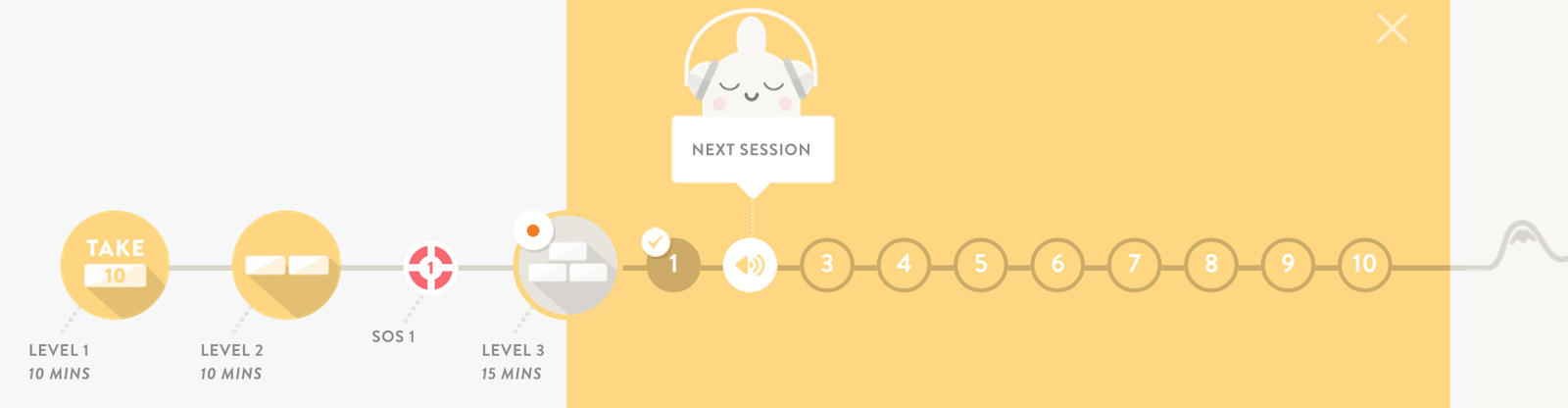
Find a way to visualize your progress.


At any point in this process, use your experience (what worked, what didn’t, and why) as feedback to identify other potential habits to try (again, try them as soon as you find them).

Warning: for the 1-month commitment, note that internal resistance occurs around 7-14 days, making you want to give up. During this period, motivation disappears (motivation is an emotion, and emotions are always temporary), and the habit is not yet ingrained. Your brain will come up with excuses like “I don’t have time” and “maybe what I'm doing doesn't matter.” Don’t give in at this point- otherwise you’ll never deliberately build any habits at all.

____________________________________________________________
More than just the habit

Bonus!!! Because of my speech warm-up, I find myself subconsciously working on my articulation throughout the day. This reminds me to pay more attention to others, and I feel a frequent impulse to smile, make eye contact, and listen to others. My morning workout reminds me to use occasional free time to go cycling or hit the gym. After a small morning clean-up for 4 months, I felt ready for a major overhaul: I gave away 60% of my possessions, and adopted a new organizing strategy that is both easy and beautiful.

You are what you do frequently. By doing things everyday, you change how you view your own identity. You no longer feel constrained by your current situation, personality, and weaknesses. Thus, the mental benefits far exceed the direct effects of daily action.

In summary, a morning routine allows you to:

  • Feel in control of your day
  • Target specific problems in your life
  • Remind yourself of personal goals
  • Warm up for the day
  • String habits together as progressive triggers
  • Dispel the excuse “I don’t have time.”
  • Gain confidence to make bigger changes in your life

All this, by expending minimal time and willpower. What are you waiting for?

Monday, June 24, 2013

June Review: Results and hard work are mutually exclusive

It's already time to reflect back on the entire month.

I was healthily hypomanic for the first two weeks. My willpower and confidence was through the roof- I felt like I had the discipline to break through any obstacle. And indeed I did. I easily wrote off thoughts of other's expectations (does X person expect Y from me right now?) and was able to focus on what I thought was most important.

I didn't get much stuff done in lab this past week. Most of what I did do failed. I'm OK with that. I was trying to accomplish a lot before next week's International Worm Meeting in LA, but I think ultimately my brain told me I didn't have enough time to do everything I had planned. My brain felt saturated- by everything I wanted to do, AND everything I thought others expected me to do. I took Thursday off to run some errands and read, and that was easily the best decision of the week.

My time is now constrained- I leave for LA on Wednesday morning, and I still need to make my two posters for the meeting and take care of some obligations. Not to mention do laundry and pack. So I have little doubt that today and tomorrow will be a productivity bonanza.

Then the upcoming Worm Meeting is the perfect chance to incorporate everything I've been working on these past few months- interviewing successful scientists, my first manuscript, practicing eye contact, teaching, literature reading, my current projects, and gathering ideas for the next phase. It has the potential to concretely advance my work in a measurable way. Time to level-up.

_________________________________________________________________________________

Embrace the Cycle

There is a clear cycle at work here. When I started this month, I thought I'd be working hard every week and be relentlessly results-focused the entire time. That's what I had developed my scheduled bursts for. But hard work is NOT the best time to get results.
  • Phase I: Perspiration. Work intensely to the point of discomfort. Acquire new skills and try new things. Ignore results.
  • Phase II: Rest. Mental distance. Do something else, and don't worry about your work.
  • Phase III: Level-up. Concrete progress. Demand results from yourself.
Phase I vs Phase II: Progress takes discomfort and hard work. There's no way around it. But that sort of mental training is impossible to maintain. As biological creatures, we need Phase II- time to rest and let our bodies and thoughts reorganize themselves. 

Phase I vs Phase III: One should NOT be results-oriented during the hard training phase. Obsessing over concrete results leads us to take shortcuts and take solace in easy and ultimately unimportant accomplishments, because it is impossible to make meaningful gains on a daily or even weekly basis. Instead of focusing on what you accomplish, focus on how you work. Refine your process and treat it like a craft. Once you have built a solid base, then you can later apply them to getting results.

Phase II vs Phase III: Phase II gives you the time to consolidate your newly acquired capabilities and build up your mental energy for the final push for results. Then, you can tell yourself during Phase III that you WILL do something amazing, and this brings the exhilaration and adrenaline required for a truly meaningful accomplishment.


The entire perspective of this post was inspired by weightlifting. My weekly workouts cycle between  intense training, a light workout, and a PR day. Analogies are awesome.

_________________________________________________________________________________

Just because I promised it

No schedule for the upcoming week, since it will be inherently dictated by the Worm Meeting schedule.

Green blocks are successful scheduled bursts, red blocks are failed, and blue blocks are prior commitments.


Thursday, January 31, 2013

The best way to start the day

Today is a ridiculously busy day. I still need to prepare my lesson for teaching at 1pm, and today is one of the few days this week that harbors a continuous block of time to get lab work done. And I want to read some papers and get some planning done. And all this needs to be done before I pick up the guest I'm hosting for PhD recruitment weekend. Since I need to take him around campus tomorrow to all his interviews and events, I won't be able to do much tomorrow other than grade papers and maybe read my 5th book. Anxiety is rising.

But I'm taking a little time to slow down and gather my thoughts for this morning on this blog. I went down to the cafe, selected their newest roast, and sat down in the comfortably spacious common area. I suppose I could've looked out at the heavy snow and temperature drop from 50 to 20 degrees as a frustration and a blockade to productivity. But I'd rather gaze out of the big bright windows, see the beauty from my warm chair, and purposefully enjoy my coffee. I let my mind settle on comfort and charm of Ann Arbor and the feeling of being at home. Simultaneously, I wonder about everything else out there on this planet and all the experiences awaiting me in life.


I like slowing down at the beginning of the day. It is all too easy to see one's massive to-do list and rush straight into work. But paradoxically, this leads to less work getting done. It's hard to focus on one's work if you just think "I have to do this today," rather than "I want to do this today." It's hard to be creative unless your mind wanders a little and brings new resources to bear on the problems you're solving. And without taking some time to think, it's easy to fall into the trap of doing urgent stuff, rather than important stuff. And that is a form of procrastination far worse than delaying your work for 30 minutes.

Since sitting down, I've determined the #1 thing I need to do this morning is perform a literature search and determine the list of gene expression assays I want to design. Then, the #2 thing I need to do is plan my teaching. Also, I need to go to the gym since I won't be able to go later. Exercise is not something I'm willing to compromise on, no matter how I busy I am. That's it for this morning until my discussion section. Nothing else will enter my mind.

Taking some time to prepare the mind will cause one's most important priorities to float to the top, where they are ripe for picking.

High-Yield Practices to Prepare Your Mind
Sometimes one can get up without direction for 30 minutes and stumble upon an idea or practice that changes one's life. Not likely, however. Some default choices for what to do to gather one's thoughts for the rest of the day:

Create. 

I created this blog entry this morning. Write, build, draw, create a connection with another human being.

Focus on a simple joy. 

Just for a few minutes, nothing else in the world can get between you, your cup of coffee, and your thoughts.

Exercise.

Work hard enough to feel discomfort. Embrace the discomfort- that attitude makes you feel ready to tackle challenges for the rest of the day. Eat some protein afterwards.

Make something sparkly clean.

But don't rush it. Consider your environment's effect on your mind.

Read something unrelated to your work.

Try to learn a new idea. Or engage yourself in a new story. Important: Don't read the news.

Generate ideas.

Doesn't matter how stupid they sound. Write them down. Create. If nothing comes to you, read something first and really consider it. Anyone can become creative if they practice being creative.

Finally, after you're all done, either plan the rest of your day, or go straight into your #1 most important and most difficult task of the day. Look at it as an opportunity.


Wednesday, September 26, 2012

My Gamified Life: Fitocracy


I mentioned in a previous post that I've made it a habit to exercise, and so I don't have to expend any mental energy to get myself there (I have plenty of other things on my mind). But I think the best way to keep a habit is to make it FUN, each and every day.

Gamification: It takes tremendous self-discipline to motivate oneself today based on some imagined/abstract healthy future. Instead, the best way is to INCENTIVIZE yourself on a day-to-day basis to exercise. Now, having society pay people to exercise would be impractical. But remember: a huge number of people play Farmville and World of Warcraft for days non-stop just to win virtual points. The incentive is further reinforced long-term by mechanisms such as leveling up, completing quests, reaching achievements, and receiving virtual tokens of support from friends. Incentives can be entirely virtual and cost nothing. Microsoft got its employees to volunteer their time to find bugs in Windows 7 by giving them virtual points People did a mind-numbing task (finding software bugs) over and over and over without pay, just because it was fun to get virtual points and compete against other employees.

Guess what? There IS a website that gives you points for working out, gives you fitness quests RPG-style, and lets you socialize all at the same time. I've been using Fitocracy since November 2011, and I think it's crazy everyone isn't using it.

The beauty of Fitocracy is the combination of two features:
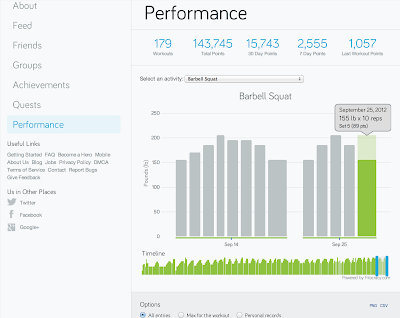
1) Incentive system that lets you track your progress. This is simply fun. During my workout, I use the iPhone app to easily enter in my exercises as I'm doing them. At the end of the workout, it rewards points based on the type of workout, the # of reps, and the # of sets (generally, points are compound lifts > isolated lifts > cardio). I automatically get a good sense of how much I accomplished, and I feel like I've earned something. I don't think twice about working out. After you accumulate a certain number of points, you level up. People give each other "Props" just like Facebook's "Likes." There are also quests and achievements. As further encouragement, it automatically graphs your progress on each exercise for you.
2) Social network. Fitocracy boasts about 230,000 users, and many of them are fitness enthusiasts and personal trainers (and a disproportionate number of cardiologists and orthopedic surgeons). And yes, lots of nerds too. You can easily find people who match your fitness interests. Many of them post pictures of themselves (i.e. before and after transformation) so you can see what kinds of results they're getting. You can see EXACTLY what exercises they do down to the last detail. Got a question for one of them? Need advice? Just ask.

Typical workout entry


These two features synergize. For example, Fitocracy has a universal set of "Achievements" that anyone can obtain. These are things like "Bench press your body weight" or "Deadlift 2X your body weight" or "Run 200 miles total." For the longest time, I was in awe of other people with the 15-pullups achievement- I started out just struggling to get the 5-pullups achievement. In the back of my mind I thought "well I'm not THAT intense- and probably won't ever get there." But then I read one profile and figured out how quickly that person went from 3 to 15 pullups… and it was less than a year. And what kind of motivation do you think I got when I achieved it last month? The habit is self-perpetuating and only gets stronger over time.

Myths: Just talking to more experienced people on Fitocracy is a great way to re-educate yourself. There's a lot of fitness controversies out here, but here are some myths that are pretty much completely debunked:
1) "I don't want to weightlift because I don't want to get bulky- I just want to get toned". OK it takes many years for a guy to bulk up lifting weights every day (unless they take steroids- not recommended). How long do you think it takes for a woman who has >10X lower testosterone? Women will slim down with weightlifting because muscle takes up a lot less space than fat. If you take 10 minutes to look around Fitocracy, you'll rapidly find dozens of counter-examples to the bulky myth (like this and this). The bulky women you see in magazines are either on steroids or are in the <5% of women who have naturally high testosterone.
2) "Deadlifts are bad for your back, and squats are bad for your knees." I used to get back pain and it's completely stopped since I started doing deadlifts. I used to get knee pain if I ran too much and now it's never a problem. You can only injure yourself if you have bad form, and Fitocracy lets you talk directly to other people (like personal trainers) about your form. Some people even post videos of themselves so others can critique them.
3) "Everyone needs cardio." Only necessary if you have a family history of heart disease or if you're training for a sport that involves a lot of cardio. Weightlifting is enough.
4) "Situps reduce belly fat." Actually, probably the best way to reduce belly fat (or any type of fat, because spot reduction is impossible) is squats because maintenance of the big muscles will divert energy from your fat reserves.
5) "High-protein diets kill your kidneys." It increases your kidney blood flow, working it harder, but that doesn't mean it's damaging your kidneys. Think of it as exercising your kidneys. Sure, people with kidney failure will worsen it if they eat more protein, but that's no different than trying to lift heavy boxes immediately after breaking your leg.

I think we're entering an age where traditional sources of information like fitness magazines and celebrity workouts have pretty much lost their value compared to just talking to other regular people like you and me who have made real progress. If you look in magazines, everyone is airbrushed and all the men are on steroids, and they don't do anything but work out. You have no way to verify the information they give you. On Fitocracy, you can see literally thousands of actual success stories from people who are just as busy as you. Along those lines, Reddit Fitness FAQ is also an excellent source of information.

Here's my shameless invite link.

Track your performance over time.
iPhone app

Friday, August 24, 2012

Friday Links: eat your egg yolks, avoid antimicrobial soap

Most of this post will be about egg yolks, but I'll start with the following PSA: if a soap is labeled "antimicrobial," don't use it. Just don't use it.

If I see antimicrobial soap at a restaurant, I don't use it. I just wash with hot water. This concise and informative blog post from Ania (fellow MD/PhD) reminded me of why I do this. The active ingredient is triclosan, but I doubt it's very active anymore because it's in a bazillion products. Many of the microbes that we would theoretically want to kill are probably already immune to it. Continued use will just give microbes more and more chances to evolve resistance to not just it but also all related antibiotics, resulting in antibiotic-resistant bacteria that could kill a lot of people. The Black Death wasn't much fun, so I hear.

The fact is, there's currently zero evidence that antimicrobial soap helps prevent infection compared to regular soap. And given the potential health risks that Ania outlines (triclosan could affect your hormones, muscles, cancer…), why the hell would you use it? You're better off not using soap at all.

Egg yolks OMG!!

For some reason, the least-significant studies seem to get the most publicity, and the media likes to create outrageous headlines like "eating eggs yolks as bad as smoking." Incredibly misleading and not at all implied by the paper- especially when you consider that the audience is the public-at-large. For some people cutting back on egg yolks is prudent (but not at all proven to be beneficial), but should average 25 year olds avoid egg yolks as they should avoid smoking? Absolutely not, and the lack of context in this article is irresponsible.

First, some conceptual background: when you drink a lot of water, do you get water intoxication? No, you pee it out. Guess what? You excrete cholesterol through your liver into your digestive tract, and you can simply make less cholesterol. Your body reacts to greater cholesterol intake by decreasing cholesterol synthesis, and you end up with the same amount in your blood. The cholesterol that your body makes on a daily basis is significantly greater (about 3-5 fold) than what is recommended in your diet. Thus, your body can easily handle twice as much cholesterol consumption as normal, and eating more cholesterol per se does not increase your blood cholesterol. Your body needs cholesterol, and it will handle it as needed.

If you don't eat this, your body will probably make it instead and you'll end up with the same blood cholesterol either way. OK, maybe not for this many egg yolks, but you get the idea.
Of course, if you drink TONS of water (>12L), you can get water intoxication (this happens to ill-informed marathon runners). So there's a point at which cholesterol intake will start adversely affecting your blood cholesterol, and yes high blood cholesterol is a huge risk factor for heart disease. Furthermore, individuals with kidney disease will not be able to deal with water overload. Similarly, if you already have cholesterol imbalances (due to genetics, age, obesity, microbiome perturbation, whatever) then you should start watching your cholesterol intake, because the mechanisms to keep your blood cholesterol in check have already been overwhelmed.

Getting to the study, I have many objections:
  1. Glaring source of recall bias. Egg yolk intake is self-reported in a questionnaire. But how many people actually keep track of their egg yolks? I'm guessing extremely few- and any variable that people do not consciously track is subject to huge memory bias. Furthermore, egg yolk intake is really hard to estimate, because eggs are used in all sorts of foods (bakery items, etc). I certainly would not trust my own estimation. And there is a huge source of memory bias in this study: people with the worst heart disease (regardless of the cause) are far more likely to "remember" that they ate a lot of egg yolks. We know that people's memories are heavily biased by their situation, and there is a pre-conceived notion out there that egg yolks are "supposed" to clog your arteries. People naturally look for an explanation for their disease, and if they find an easy explanation (eg egg yolks), then they will sub-consciously alter their memories to believe that they ate more egg-yolks. The memory effect should get stronger with greater severity of disease, and so all of the results of this paper could be explained by recall bias. Furthermore, the study itself can influence people's memories. You're going around a clinic full of worried people asking them how many eggs they eat. At least subconsciously, people are going to start blaming eggs for their health, even if they ate the same # of eggs as the next person.
  2. The study population is heavily biased. The patients are already attending a vascular clinic! As I mentioned, there are likely sub-populations for whom cholesterol intake will increase their blood cholesterol (morbidly obese individuals, patients with familial hypercholesterolemia who are genetically unable to regulate their own cholesterol, etc). Those are the sub-populations whose cholesterol homeostasis mechanisms are already out of whack, and they are the ones most likely to be attending the clinic.
  3. The data is nothing but correlative. Eating egg yolks (self-reported, again) is shown to be correlated with artery blockage. Sure, they use some statistical analysis to show that the effect is still present after you adjust for "coronary risk factors" but many risk factors are still unknown (yay science!), so you can't adjust for everything. The problem is that there are thousands of variables out there, and they are all correlated with each other to different degrees. People who live in a certain part of the country might eat foods rich in cholesterol, but guess what- that might also be the most polluted part of the country. Or there is a virus circulating in warm climates that increases your risk. Or people in that part of the country might be older, etc. If you look at 1000 variables, eventually you'll find one that fits simply by chance.
  4. Simplistic clinical endpoint. Small point, but they just looked at neck artery blockage. Artery blockage, even if systemic, does not translate to disease. It's a risk factor like any other, and like all risk factors it doesn't affect all individuals in the same way.
Plant Zen

Finally, I have no idea what to make of this. You can hook up a plant (any plant, like a potted plant) to your computer, and somehow an electrode in the soil can tell what part of the plant you're holding. So you can control your computer by touching a plant. Is this a hoax?

I predict that eventually we'll be able to hook up anything to computers. But I think it will take a little more than just sticking an electrode into the soil.

wtf?

Sunday, June 24, 2012

5x5 idea warm-up: grateful, proud, forgive


As I've previously reported, the Idea Habit has been by far the most fun, successful, and useful goal that I've implemented this month. Thinking back on it, I went through 3 phases. 
  1. A fun phase where I was just experimenting with it. I look back and the ideas were just terrible. However, it was relatively easy to get ideas out into Evernote because I wasn't pressuring myself. 
  2. A frustration phase. I started subconsciously thinking, "my idea topic and my ideas need to be really good," especially because I started sharing my ideas with other people. Thus it would sometimes take up to an hour to accomplish my habit- and most of it was just trying to come up with a good theme for my ideas. And stress just makes my ideas worse. What a waste.
  3. A self-improvement phase. Out of my frustration I started thinking about the process of generating ideas so that I could make myself more efficient. I started deliberately exposing myself to inspirations, reading about creativity, and trying out new environments for creativity (various cafes, nature walks, in a push-up position, etc).

Throughout phase 3, I also started thinking about how to expand my Idea Habit to become more than just a daily exercise. Idea topics such as "How Google Glasses might affect biological laboratory research" and "top 10 animals I'd like to ride" certainly are interesting, but have rather narrow application. While the Idea Habit is worthy in its own right, I feel it has the potential to affect everything else I want to accomplish.

Thus I have just today introduced "5x5 Idea Warm-Up Time" to start off my daily idea sessions. I come up with 5 ideas for 5 idea lists, for a total of 25. These are important topics that are worth thinking about every day, but because I am thinking about them everyday, I don't pressure myself to make them really good ideas. At the same time, it just gets my idea juices flowing so I don't get stuck for an hour just trying to come up with a topic.
1) 5 things I'm grateful for (i.e. brainstorming things I can do for other people)
2) 5 things I'm proud of (i.e. what are my strengths and how can I maintain them)
3) 5 things I forgive myself for (i.e. what are my weaknesses and how can get better)
4) 5 new things I can try today that I've never done before
5) 5 things I can do today to make myself a better scientist and thinker
Again, if these ideas suck, so what? It just takes 1 good idea out of 100 to make a difference in my life. I'm going to limit this 10-15 minutes per session so that I can move on to my main idea list of the day.

Separately, I've also started coming up with 5 ideas for experiments while I'm doing my morning routine of writing out all the experiments I need to do in a day. Usually I end up doing one of them that I otherwise don't "need" to do.

Starting off with a "lite" version of whatever you need to accomplish is generally applicable. It's pretty much a combination of two eternal motivation pearls: 1) tell yourself you're going to just start your task, dedicating just 5 minutes to it and 2) break your task up into smaller chunks. Aren't feeling social but you're going to an important social event? Just start talking to someone, accept that it's going to be awkward, and give it your best shot. Feeling tired but you are committed to working out everyday? Just start doing your routine with lighter weights. Don't waste time stretching- it's just procrastination and there isn't any evidence of benefit. Just start, just start, just start.

In completely unrelated news, I donated blood this week.
This is what will happen to whoever receives my blood.
Also, I found this epic video while researching my idea list "top animals I'd like to ride." 
Water buffalo herd versus lion pride versus crocodiles. AWESOME.


Friday, June 15, 2012

Idea Habit: 2-letter Scrabble words and Blue Harvest


At the beginning of June I listed 5 goals for the month that I wanted to accomplish each and every day. I will likely post an update on my progress next time, but today I will just quickly share some fun results of my idea habit. Essentially, I practice using my "idea" muscle by coming up with lists such as "10 chapter names for an autobiography," or "ways to stay awake during a lunch talk," or "10 skills I need to learn in lab." It's the only habit that I've fulfilled this month so far without fail, probably because it never takes more than 30 minutes each day. So far it has two advantages: #1 I actually use the ideas I generate, and #2 I have an easier time being proactively creative in lab. I organize all of my ideas into a note in Evernote.

Today I'm just going to share two of my idea lists that I created this week.

Memorizing two-letter words in Scrabble (6/11 and 13)
Knowing all the 101 two-letter words allowed in Scrabble would be really useful for even the casual Scrabble player, but how to remember all of them? For each letter, I've created acronyms, mnemonics, visual images, and word play to help me remember what other letters can be paired with that letter. The more ridiculous a memory trick is, the easier it is to remember. My favorites are bolded.
A full list of two-letter words can be found here: http://www.trussel.com/scrabble/2words.htm
A: A MAN'S SEXY RIGHT LAW BLADE
B: B a vowel but don't B U
D: DOE
E: E is too good for other vowels. E fed me red sexlet hens  
F: FAr East
H: HAI EMO
I: ISN'T DIF
K: KIA (killed in action)
L: LIe On your Ass
M: M&Ms + vowels (imagine M&Ms with all the vowels written on them)
N: NAh, NEed NO NUts
O: OX FED, Y PRESS HIM NOW
P: A PIE
S: OH SHI-
T: TO TAme TIme
U: U PUSH MUTT
W: WOE
X: I + U = XXX
Y: Imagine a slingshot dealing AOE (area of effect) damage
letters with only one word: JOe's ZAny GO-RE and QI
Since when are ut, ti, na, ne, and qi official words of the English language?
Space-themed names for Frisbee team (6/12 and 14)
For the summer I joined the Ann Arbor Summer Frisbee League to get my Ultimate on. About 210 people, split up into teams of 15 (>>7 since a lot of people will take weeks off in the summer). We were asked to come up with ideas for a team name based on Space, this year's theme. Also, our team color is Blue, so bonus points if a name takes that into consideration.
Earthshine
Blue shift
NepTune Up
SaTurn Over
Hammer Time Continuum
Helio Hammers
Solar Flick
Space: the final FUNtier
May the Force Flick be with you

My buddy Jake came up with Blue Harvest (Family Guy reference), which I loved instantly and everyone jumped on. So here's to a great season Blue Harvest!

Edit: I deleted the Family Guy picture after I realized that it was solely responsible for this post getting 5 times more hits than any other post. It comes up way too high up on Google Image.

Thursday, May 31, 2012

Veggies for non-hippies


Vegetables are a wonderful thing. It's hard to be satisfied with a meal unless it's chock full of them. One of greater freedoms of Ann Arbor is that one can be at Michigan's center of cosmopolitanism and fine culture one minute, and 20 minutes later (driving) be enjoying nature's peace of mind. I would've had to cross state lines back in Boston to do the same thing. In this case, nature is the farm that will grant me all my veggies for the summer. I've signed up for a farm share this summer, splitting it in half with my fellow MD/PhD student Ania. I participated 2 years ago and was deluged in earthly goods- some weeks I received in excess of 15 pounds. For those of you who don't know, a CSA farm is Community-Supported Agriculture (http://www.localharvest.org/csa/), where the idea is that you cut out the middle man, know your farmer, and know exactly where your food is coming from. From a more practical standpoint, you pay up front at the beginning of the summer (usually a couple hundred dollars) and get your vegetables in bulk each week for 18 weeks. It's enough for a family of 4 (which is why I split mine). The convenience is astounding- it's really easy to underestimate the time and thought spent at the supermarket selecting vegetables. The effort required in the aisles is just one more barrier to healthy eating, driving people to the pre-packaged food. Some weeks at the CSA you'll get 15 different kinds of vegetables all in one box, including ones you might have never tried otherwise. Great way to expand your palate without having to give it much thought.

This was the first week, early in the summer, so the harvest is only starting to pick up. It's mostly greens this week- later on there will be loads of squash, radishes, zucchini, bok choi, potatoes, spicy peppers, onions, tomatillos, basil, eggplant, melons and dozens of other kinds… heck there's even chocolate mint leaves. Since it was picked the day before or the morning of, everything has a wonderful earthy scent. The arugula in particular smells and tastes nuttier than anything I've ever found at Whole Foods.
A half-share of farm veggies. It's still early in the season so we're getting just greens- but there are some extremely large harvests to come! Top row: bean tops, mustard greens, chard, arugula. Bottom row: green onions, carrots, spinach, and a variety of herbs (chives, cilantro, lavender, sage, rosemary).
What will I make?
  1. salad of arugula, mustard greens, and chard
  2. stir-fries spiced up with some herbs, green onions, and beantops
  3. eat the carrots straight up
  4. GREEN SMOOTHIE from the spinach. I drink on average 1.5 smoothies per day, so my $10 personal-sized blender has seen a lot of action over the years. Peanut butter + spinach = heaven. Like most things in life, don't knock it until you've tried it.

Monday, May 28, 2012

Thank you and monthly reflections


Hello! Well, this is now blog entry #7, and I've essentially succeeded at my public goal of writing 2 blog entries per week for a month! Technically I still have one more before I can pat myself on the back, but I'm saving Wednesday's post for something else (A.O., don't give it away in the comments). I'd dearly like to thank all of my readers for following me in this mini-journey. It's sometimes a little addicting (and vain) to watch Blogger track the # of views after I've posted each entry- but I just find that having an audience for my thoughts to be really good motivation to think more deeply. 

But I think going forward, I'm going to modify my blog goal a little bit. First, two major blog posts per week has been sucking up a lot of time- I know it will get easier, but I think I can cut down. However, one blog post per week doesn't seem like enough. Second, I've found that while I'm in the writing process, my blog posts usually balloon to far longer lengths than I originally intend, and I'd like to work on the art of writing concise, quantized posts that are still useful. Thus, I'm going to write 1 major blog post per week, and 1 short post per week (1-3 paragraphs).

Speaking of goals, since the beginning of 2012, I've been doing monthly assessments of how my life is going, monitoring the progress I've made on my goals. It's almost June 2012, and this blog seems like a logical forum for me to flesh things out. I always have a whole bunch of goals that I set for myself and I'm constantly generating new ones as I go through everyday life. I make some progress on all of them, but never satisfactorily. Sure, since the beginning of the year I've definitely gotten better at seeking out interesting strangers to talk to, gotten a lot more organized, been keeping up with my friends and family long-distance, wasting less time on the Internet, keeping my e-mail inbox empty, and reading a lot more. But I think what I'm missing is focus: because I have so many goals, I find it hard to pursue these goals to the point where they have a measurable impact on my life. Also, without a way to internalize and constantly remind myself of my most important goals, it is way too easy to get distracted or to waste time. Finally, having so many goals just makes me stressed that I can't handle all of them.

Writing regular blog posts is one of the few goals that I've been fully satisfied with, and I think it provides two major hints as to how I can solve my focus issue. 1) Announce and make public all of my major goals (i.e. in this post). 2) Simplify. Focus on just a few goals and don't dedicate significant time to anything else until those goals are achieved each and every day, each and every week. 3) Review- throughout each day, review my priorities for the day and ensure that my goals are being achieved.

This month, I'm going to focus on 4 major goals that I've been putting off. 
  • Generate a list of ideas everyday. I'm a fan of James Altucher's blog, and one thing that he does is write down lists of ideas every morning. Basically exercising his "idea muscle" so he has no problem being creative when the situation calls for it. He's even turned some of the ideas from his list into businesses. Some lists I could generate: 30 things I'm grateful for, 10 things I did that were productive in the last week, 20 chapter names in my own autobiography.
  • Wake up at 6am every morning. I did this in January and it was fantastic, and I have two good tools at my disposal to keep up this goal: 1) Sleep cycle alarm clock. This iPhone app (see photo on right) uses your iPhone to pick up vibrations to detect when you are in deep REM sleep (muscle paralysis) and when you are in the lighter stages of sleep. You give it a time interval for it to wake you up (like a normal alarm clock) and then it will only wake you up if you're not in deep sleep, so when you wake up you feel far more rested. (credit: first found out about this from my friend Dale's blog) 2) Practice, literally. Lie in bed, set the alarm clock for 5-10 minutes later, and get up immediately and perform a putative morning routine. Idea from Steve Pavlina's blog
  • Read at least a full paper and 3 abstracts/intros/discussions every day. I briefly discussed this in my post from May 13, and I think that establishing regular reading habits right now in my training should be a top priority. Too often at lab my mind is so focused on experiments that I have a hard time setting aside time for reading, unless it's a paper that's directly relevant to what the lab is doing right now.
  • Develop a long-term lab plan with all of the experiments I am going to perform over the next month or more. So far I've only been planning each day's experiments in any real detail (which has been highly successful). I can anticipate all of the big things that I need to prepare for long-term, but it's hard to evaluate how much progress I really make over a month. My plan is to write the outline of a potential paper, look at all of the components, and decide when exactly I can perform all of them. Then, I will review it daily and decide whether or not I've made progress towards completing my plan.
Finally, I'm going to keep up two other habits to make sure I don't slip. 1) Read 40+ pages of a book every night, and 2) Skype with family once a week, and skype to catch up with a friend once a week.

All of these are going to be on a notecard in my pocket, on a post-it note on my computer, on a post-it note at my lab desk, etc.
1) Focus on stated goals to the exclusion of all others. Don't get distracted by new ideas- save them for next month.
2) Generate a list of ideas. Or, find another mentally challenging task to perform.
3) Wake up at 6am.
4) Read paper + 3 abstracts
5) Develop long-term lab plan

I thought about acronyms, mnemonics, and other mental tricks to internalize these goals. In fact, I used my idea habit to generate a whole bunch of ways to internalize "focus, ideas, wake up, read, plan." These ideas can be as ridiculous as I want. Here are three highlights:
Mnemonic: Furious Igloos Wear Religious Placemats
Link system: The focus (of an ellipse) had an idea orbiting it. Then the idea exploded and woke up from a nightmare. In the wake of this event, reading was banned. Fortunately, the Cylons have a plan to get reading back.
Mnemonic: Fine Ideas Want Radical Processes

Somehow, the third one jives with me the most. Hence, I will internalize Fine Ideas Want Radical Processes. I'll probably back it up with my link system story.

Sunday, May 20, 2012

How I'm stopping myself from mindlessly wasting time on the Internet

As promised, I've written a continuation of my last post, "I like my prefrontal cortex but it naps too often," where I semi-ranted about my addiction to wasting time on the Internet. It can be summarized as two conundrums: 1) The flexibility and power of the computer/Internet is both a blessing and a curse, both a tool of incredible productivity and incredible distraction. 2) Once you start being distracted and wasting time on the web, you can't stop. Your prefrontal cortex goes into hibernation and your biological ability to refocus on work is clamped down.

For a while now I have felt like what I'm doing with my life only superficially resembles what I want to be doing with my life- sure, I'm in an MD/PhD program studying aging and longevity, while still having a social life and keeping fit. But if I actually look at what I'm spending my time doing, it feels like relatively little is dedicated to my long-term goals. Would I ever tell myself or another person that my goal in life is to waste time on the Internet? No? Then why I am spending so much of my time doing it?

Before we start, I'm loving the comments- keep 'em coming! Share your own experiences with the Internet below- we always make fun ourselves for wasting time but it's usually hard to get a good conversation going on about how to actually fix it.

A closer look at the problem- where can we intervene?
I started looking more carefully at what exactly happens when I suddenly lose 3 hours of my day to wasting time on the Internet. In particular, I looked at how these sessions begin.
  1. URL autocomplete. My biggest enemy. On my computer Internet browser, I can click the URL bar and press "f" and autocomplete will take me to Facebook. Same for "g" (gmail), "h" (huffingtonpost), "t" (the crimson), "e" (en.wikipedia.org), "i" (intrade), "n" (nytimes), "d" (daily show) and "y" (youtube). Therefore, I can randomly hit keys on my keyboard and I get automatic reward. What could be simpler?
  2. Random cues/distractions scattered in every window. Obviously, there are links, and I don't have much control over that. But there also used to be about 20 tabs open in my browser, and my eye skimming any one of them could distract me. Also, a whole bunch of different programs open. I used to check my e-mail all the time and find thousands of junk e-mails I hadn't bothered to delete, as well as a bunch of important e-mails I had been putting off. All of these things can trigger Googling things related to the cue/distraction and checking relevant web pages, which inevitably leads me down the path of clicking links. It also doesn't even help that some of the cues are work-related, because that just makes me anxious that I'm not doing my work.
  3. Random distractions everywhere else (not on my screen). This includes my phone, the clutter on my desk, my kitchen, other people, little tasks I need to do around the lab. Real life being messy just makes me more likely to want to just look at my computer.
  4. Lack of motivation. I'm procrastinating (duh) on my work. The best pearl I've heard about procrastination is that I'm procrastinating because I haven't thought about why my task is important. Sure, I may know generally why worm genetics can reveal all sorts of insights into diseases of human aging, but this bird's-eye view doesn't cut it on a day-to-day basis. I need to get specific about why I should be focusing on my work, or else I'll be inclined to start hitting random keys on URL autocomplete.
These combine to form the following scenario: I am overwhelmed by the stuff I need to do, and the distractions everywhere around me prevent me from thinking about why I should be doing the work I need to do. Thus my habit of wasting time kicks in and I start hitting random buttons and my URL autocomplete takes me to pages I check way too frequently and then I'm on the road to clicking link after link, and by then my brain has shut down.

Any solutions?
Now that I've better delineated the challenges, I can give an overview of the solutions I've been working on.
  • Don't bring my laptop home. Only use an iPad at home for Internet consumption
  • Compartmentalize my day. Lab is for work. Home is for personal development, reading, and entertainment. Cafe can be more flexible, but I give myself a pre-defined goal beforehand (like writing this blogpost right now).
  • Give myself a routine at work to prevent me from getting distracted.
  • Organize my stuff. All the time.
Internet consumption: only on my iPad, and only at home
I leave my MacBook at lab, and I only use an iPad at home. This was surprisingly helpful, and I think it pretty much solves the URL autocomplete and random cues/distractions problems. I of course need all of the functions/features of a computer to do my work at lab, but I really don't need it at home. I didn't buy an iPad until the most recent iteration because my computer could do everything an iPad could do and more. But I discovered that the limitations of an iPad are actually an advantage.
  1. URL autocomplete is technically there on the iPad, but the awkwardness of the keyboard makes it so my hands can't efficiently do it without some thought. Thus, the lower portions of my brain can't compel my hands to start doing this. It also makes it harder for me to perpetuate time-wasting sessions. After all, I do frequently hit dead ends on the Internet (no more links to follow). At that point, I can stop and think, or I can randomly hit buttons for URL autocomplete or click on bookmarks on my MacBook. But on my iPad, I'm left with no choice but to stop and think about what I should be doing next.
  2. It's simply a different interface than my computer. All my old habits just don't work in the same way and it's easier to shake them. It's likely starting anew! For example, it's much harder to navigate the web on an iPad. Maybe I'm just not good at it yet, but the very existence of the obstacle means it's impossible to go on autopilot. And again, it is the autopilot mode which makes these time-wasting sessions possible.
  3. iPads only have one window open at a time. That means no cues to distract me. That means I can focus on my Kindle app book without seeing the YouTube window I left open on the side. Furthermore, it's more difficult to shift from app to app than it is to click around on a computer, so again, I avoid autopilot.
Compartmentalize
Most importantly, I CAN'T do my work on my iPad. This can be a good thing assuming I combine it with my next strategy, compartmentalization. I tell myself I'm not going to be doing lab-related things at home so I no longer feel guilty that I'm not doing work. Likewise, at lab I don't feel like I'm depriving myself of Internet entertainment because I am reserving that for when I get home. At home I can focus on personal development goals, or read a good book on my Kindle iPad app. And if I do just feel like vegging out and wasting time on the Internet, the prospect of work no longer hovers over me and makes me anxious, so the time-wasting actually does help me relax.

Routine- distract from the distractions
So if I don't bring my computer home, then what about work? The challenge is that I need my computer to do my work, so I have to deal with the possibility of distraction. But I find that having a routine stops me from defaulting to time-wasting. I let myself slip from my routine this week, and despite working longer hours I got a lot less stuff done. The routine is as follows:
  1. I already have my first major task of the day prepped the night before. This can be a blog entry, a major lab task/experiment, reading a paper, working on a grant, etc. I do that first thing.
  2. Put my laptop away into my drawer (assuming I had to take it out in the first place). I write down (on paper) everything I need to do that day. Think about why I need to do each item. Usually I combine this with organizing my desk since I likely have notes and images scattered around my desk from the previous day's work.
  3. Only then do I take my laptop out of my drawer, look over my (electronic) lab notebook to finish up my to-do list. I close all tabs and programs not relevant to my current tasks.
  4. Come up with a general plan for the day (consulting Google Calendar) and since I'm already thinking about my work, it's pretty easy to just get out of my chair and start prepping my reagents.
  5. Select a task (or a collection of related tasks), remind myself of why it's important, then set a 50-90 minute timer. Work on it uninterrupted. Once I've identified why the task is important, it's much easier to perform computer tasks without getting distracted. Then take a break, but don't open my computer unless I'm planning on going through e-mail or organizing my electronic lab notebook. Set a 10-15 minute timer for this break, then go back to work.
I also copy the single-window nature of the iPad as much as possible on my MacBook. I close out of windows and browser tabs as frequently as possible to prevent me from getting distracted.

Organize
This applies to pretty much everything- e-mail, desk clutter, browser tabs, lab notebook, Evernote, lists. I doubt I have anything right now to contribute to the expansive body of advice on how to get organized, except to say that if you're wondering how to get organized and don't have time to explore all of the online advice and experiment with it, I'd recommend a very short and simple book called Zen to Done.

Final thoughts
I should reiterate that I still look at Facebook and I still look at random crap on the Internet. I think it's actually pretty important because I discover random useful things that way. Distraction can be a good thing, if and only if it gives me new ideas, lets me look at my work with fresh eyes, or helps me genuinely relax. The goal, of course, is to prevent it from snowballing into a waste of 3 hours of my life.


The main challenge for me in breaking this bad habit (wasting time on the Internet) was that it was interconnected with a bunch of other bad habits (like abusing URL autocomplete, being disorganized, not thinking about why I'm doing my work frequently enough, and letting stuff build on my laptop windows and my desk). I'm still working out the kinks of this, because it's impossible to address a whole bunch of habits at the same time- you get distracted if you try. Thus, it has taken me many months to implement a system that had any meaningful impact on productivity. But frankly, it took me years to acknowledge that I had a problem with Internet time-wasting in the first place. And the most important thing I discovered? The very process of eliminating a bad habit is fun- even better than the satisfaction of eliminating it at the end.

About Me

MD/PhD student trying to garner attention to myself and feel important by writing a blog.

Pet peeves: conventional wisdom, blindly following intuition, confusing correlation for causation, and arguing against the converse

Challenges
2013: 52 books in 52 weeks. Complete
2014: TBA. Hint.

Reading Challenge 2013

2013 Reading Challenge

2013 Reading Challenge
Albert has read 5 books toward his goal of 52 books.
hide

Goodreads

Albert's bookshelf: read

Zen Habits - Handbook for Life
5 of 5 stars true
Great, quick guide. I got a ton of work done these past two weeks implementing just two of the habits described in this book.
The Hunger Games
5 of 5 stars true
I was expecting to be disappointed. I wasn't.

goodreads.com