More on balancing productivity and relationships! Again, I’m writing a lot of this for myself.
This series of blog posts was partially motivated by a reader’s question about defending one’s time while also maintaining relationships. It’s an important question, but there’s an important nuance. Yes, it is critical to defend your time and say “no” to a lot of things- even to your boss. But make sure you are effectively managing and utilizing what free time you already have before you start asking for more.
In fact, utilizing your current free time more effectively is key to obtaining more autonomy later on.
_______________________________________________________________________________
Rule #1 can be summarized as: Schedule dedicated time to invest in your relationships and your ability to build relationships. This solves a lot of conflicts.
Rule #2: The First Step: Gain others' trust by proving your value and honesty
On value
There is a fantastic interview in Cal Newport’s book So Good They Can’t Ignore You. It’s worth repeating. After graduating from college, a young woman named Lulu takes her first job. It's a mindless, boring job pushing buttons to test for software bugs, and she doesn’t have much control of what she does and when. She just follows orders from an unending parade of micromanaging bosses.
While defending one’s time and acquiring autonomy is critical for taking control of one’s work life, it would have been a mistake for Lulu to start doing that immediately. Instead, she used what little autonomous time she did have (mostly her free time at home) to build skills above and beyond her job requirements. Instead of watching TV, she spent countless hours learning how to code on her own, and re-write the company's underlying computer system.
Eventually, she figured out how to automate the company's entire bug-testing process, saving it a ton of time and money. No one asked her to do this. Her bosses were impressed, and she was given a major promotion heading up a new software automation division with lots of responsibilities that probably had her working 80 hours per week. At this point, Lulu was really valuable. So she decided to demand a 30-hour per week schedule to reserve enough time to focus on her side projects. They couldn’t say no- they needed her.
Therefore, if you feel constantly harassed by external responsibilities, a micromanaging boss, and other demands, don’t just try to fight them or avoid them (or worse, complain). Increase your value by any means necessary and then you can negotiate your time commitments on a more equal footing.
Now, PhD students are given a ton of autonomy and then must learn how to use it effectively. I didn’t need to “earn” it like Lulu did. However, the pattern still holds. Early on in my PhD, my boss would give me a project with specific goals and I’d work on them. If I didn’t fulfill them (which happened a lot early on), it would be a problem. I had other project ideas, but I honestly didn’t know how to execute them, so my boss’ ideas came first.
I started coming up with solutions that my boss hadn’t considered. I delivered surprise results. I took note of what areas my boss was not focusing on (rigorous statistics, bioinformatics, automating common lab tasks), and dedicated time to learning how to do those things. Today, it’s pretty clear my boss is happy with my progress and fully trusts me to figure things out on my own. His ideas are now (very helpful) suggestions, not requirements.
Every PhD student has the time and autonomy to build skills above and beyond what is immediately required for the project they are given by their boss. If a corporate indentured servant like Lulu can find time for it, so can PhD students.
Book recommendation: Cal Newport's So Good They Can't Ignore You. Lots of good stories like Lulu’s.
On honesty
Being trusted is more important than being liked. So don’t be afraid to piss people off. Don’t go around pissing people off on purpose, but if honesty necessitates some uncomfortable words, go ahead.
If someone else is causing you problems, the solution is simple: talk to them about it. Don’t complain, and certainly don’t write them off as inept or uncaring. If someone else is demanding too much of your time, make sure they trust you and don’t just think you’re lazy for saying “no.” If you prove your honesty first, they will believe you when you say you are too busy.
Just like defending your time, don’t go overboard with this immediately. If your boss has some major flaws that are hurting your company, don’t walk into your her office and start criticizing her management style, unless she is already very open to feedback.
Instead, start small. If someone says, “I love New York!” and you really dislike New York, don’t be afraid to say, “Being in New York City makes me want to blow my brains out.” Even if this person greatly outranks you. Most people are secure enough to not take offense at a trivial preference like that. The very fact you are disagreeing with them shows them that you are telling them the truth. Of course, don’t be unnecessarily mean about it, but don’t be afraid to be polarizing.
Then, move up. Be open with your criticisms of your organization’s plans. Be open with what you support and don’t support. Even if your boss started off squelching feedback (I hear this is a common issue in the corporate world), but if you’ve built up trust, you can always get to the point of full honesty eventually.
_______________________________________________________________________________
Finally, note that neither of these things, proving value and proving honesty, requires you to get more free time first. You just have to do it. And it will open many doors later on.
Showing posts with label books. Show all posts
Showing posts with label books. Show all posts
Wednesday, December 11, 2013

Saturday, February 23, 2013
A Story Not About Passion
Left for dead on the day she was born because she was a girl, Fawzia Koofi is now the deputy speaker of the house in Afghanistan and running for president in a society where many still do not believe that women should even be educated. She has perservered despite being on the run for much of her life, first from the mujahideen, who killed her father, and then the Taliban, who took away her freedoms and killed her husband and many other family members. Her soul fell as she watched all the progress towards modernization and women's rights crumble under civil war and Taliban rule. She has faced death many times throughout her life, and she still withstands regular assassination attempts.
Clearly, Fawzia Koofi is a remarkable person. But millions of Afghans have gone through virtually identical experiences. How did she become remarkable?

When you listen to Fawzia Koofi now, like during her appearance on the Daily Show, you might think that what makes her remarkable is her mission. The significance of her mission is obvious: poverty, women's rights, political reform, ensure her duaghters do not suffer as she did.
Technically, it is true that Fawzia's mission makes her remarkable. Unfortunately, it would be all too easy to take the wrong lesson from her, just as many people took the wrong lesson from Steve Job's Stanford speech.
Too many people, including me, thought that the lesson is "Find your passion."
"Find your passion" is a terrible, terrible advice.
Or rather, it is highly misleading. Fawzia Koofi and Steve Jobs did not START by finding a compelling mission or purpose. Fawzia started by insisting that she receive an education, even while on the run, and much to the resistance of her family members. She had no time to think of a mission- she was only a child when she had to start fleeing from death on a regular basis. And it was this education that made her unique. At a time when it was nearly impossible for a woman to get an education, she got one. In other words, she had rare and valuable skills.
Notably, she did not originally intend to go into politics. The idea developed relatively late in life. But her skills got her noticed, and she was given the opportunity to run for Parliament, mostly made possible by chance events. Her mission only started developing in earnest many years after she began developing her skills. Even when she was well on her way to fame, she said she felt "mentally lost" and "purposeless."
During this time, she still had to build her skills constantly, in particular in giving speeches. This ability is what ultimately gave her the power to start building women's education centers in conservative villages, to start standing up vocally for women's rights, to get on the international stage. Only now does her mission seem clear. Her passion was a side effect of getting really good at what she does.
In summary:
Wrong: Look inward and decide passion => go follow the passion
Right: look outward and see what skills might allow you to offer value to others => develop skills => explore many missions while developing more skills => find passion. Or rather let passion find you.
_________________________________________________________________________________
I Know My Passion... Not
I'm 7 books into my effort to read 52 books in 52 weeks. This blog entry was my attempt to explain Cal Newport's So Good They Can't Ignore You using the example of another book, Fawzia Koofi's Favored Daughter. He uses many case examples to rigorously debunk "Follow your passion."
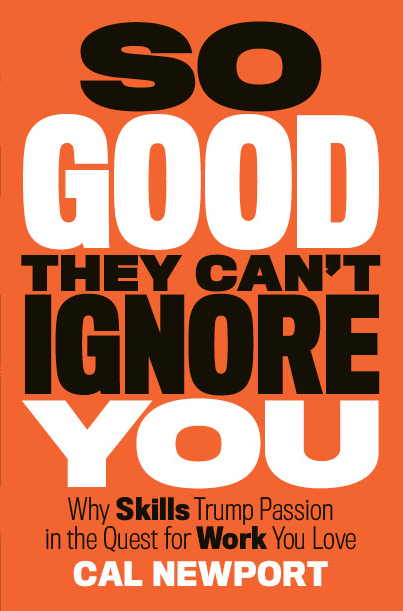

You may remember my blog entry "I'm lost. What's my purpose in life?" Cal Newport's book pretty much solves everything. I don't need to feel bad that I haven't found a purpose, because a purpose is only possible after I've spent decades developing valuable skills. My most meaningful career accomplishment will likely be something I never imagined.
I also noted that Cal Newport, being an academic, provided really really good advice for graduate students (and in general, anyone who is trying to create knowledge). I've already begun implementing his paradigm into my work (see below).
Below, I've copied my notes on Cal Newport's book. But seriously, go buy So Good They Can't Ignore You right now.
_________________________________________________________________________________
So Good They Can't Ignore You
Popular paradigm: look inward and decide your "passion," develop the courage to leave your job and go follow your passion. Then develop passion-oriented skills and do what you love.
New paradigm: Pre-existing passions don't exist. Even if they did, you would first need rare and valuable skills to back them up, called career capital, or you will fail. To find a compelling mission for your life, you need those skills first so you can explore many possible missions. You can develop career capital in nearly any job, because you can usually apply skills to other fields. Start NOW, in your current job. Careful: the more skill you acquire, the more others will try to convince you to help them or follow a traditional path, but stay focused on what you believe will make the most impact. Use your value to demand more autonomy and surround yourself with people you like and work well with. Then, use your autonomous time to develop your own missions. These are tentative missions - anything that seems interesting and important at the time. Your mission will constantly change, so be comfortable with it. Some missions will reveal themselves serendipitously- if you have the skills then you can take advantage of opportunities. Others will be brought to you because of your skills- people want to work with you. Learn as much as you can, brainstorm ideas, and put them into action in small projects. This will allow you to continuously expand, refine, or replace your missions until you believe that you are both working right and doing the right work.
Important: these are not a series of steps. They define a lifestyle. Different aspects are more important to focus on a different times. Career capital is most important for a 20-something, for example.
What Can You Actually Do Right Now?
Bold: Goals
Italics: specific activities that bring you closer to the goals. Do these on a regular basis.
General principles
- Develop career capital - rare and valuable skills that make you so good/interesting that others cannot ignore you
- Explore possible life/work missions - these will allow you to constantly refine your skill set, explore opportunities and develop a mission
- Time tracking - track time spent towards high-yield activities, i.e. those that develop career capital and explore possible missions. These include deliberate practice and feedback, background research, little bets, serious study of others and others' work
- Autonomy - YOU must make time for high-yield activities
- Prioritize these over simple productivity
- Turn down prestigious positions that saddle you with responsibilities
- Surround yourself with likeable and talented people who respect your autonomy
Career capital
- Identify rare and valuable skills that make the most difference in your current field or are generally applicable to any field
- Study people who have rare and valuable skills
- Develop rare and valuable skills:
- Deliberate practice - strain yourself and embrace discomfort and ambiguity
- Seek immediate, clear feedback, esp from mentor/coach
Mission and impact
- Mission: Determine a tentative mission
- Study people who have compelling missions and interesting careers
- Cutting Edge: Do research and constantly scan for your field's next big idea - the "adjacent possible"
- Background research: Learn new ideas in your field through reading, meetings, talks
- Research Bible: Summarize idea-of-the-week in your own words
- Idea notebook: brainstorm own ideas
- Daily walk: free-form brainstorm related to the tentative mission
- Little bets: small exploratory projects (<1 month) to test your ideas
- criteria: must do at least one of the following:
- force yourself to master a new skill
- produce novel results
- grasp the attention of others (i.e. be remarkable)
- Seek concrete feedback, especially from others
- obsess over self-imposed deadlines
- publicize your little bets in a setting where word can quickly spread if the idea is good enough
- Reflection: Evaluate concrete feedback from little bet, alter or replace tentative mission, guide further research, plan next little bet
- Take 1 full day off per month for reflection
Thursday, January 10, 2013
Update: 2013 Reading Goal
It is now January 10. I am 10 days into my goal of reading 52 books in 2013. Last night I finished Happiness: A Guide to Developing Life's Most Important Skill, which was decent. I already agreed with the author that happiness is a skill (see prior blog post), and many of the chapters seemed redundant. If you're looking for a better and more succinct version, read 7 Habits of Highly Effective People. I did however enjoy the science chapter where they use fMRI and EEG to understand the physical basis of happiness. The author is a scientist-turned-monk, after all. Before that I finished The 4-Hour Chef, which gave me a lot of ideas on how to learn to read more effectively (it's a book about learning, not cooking per se). I have lots of ideas for holding myself accountable, making the project interesting, and deliberately improving my reading skills.
For the rest of the month, I intend to read two of the following:
The Emotion Machine
To End All Wars: A Story of Loyalty and Rebellion
Catching Fire
The Universe Within: Discovering the Common History of Rocks, Planets, and People
So Good They Can't Ignore You. I hear this one is a good read if you're trying to "Find your passion" and are getting nowhere.
If I find a book is very long, I may give myself two weeks to read it. And then I will make that up by reading 2 short books in 1 week.
I've been pretty busy between research and teaching, so I haven't been able to write up a post on the specifics of my goal plan. But it'll come. I promise!
For the rest of the month, I intend to read two of the following:
The Emotion Machine
To End All Wars: A Story of Loyalty and Rebellion
Catching Fire
The Universe Within: Discovering the Common History of Rocks, Planets, and People
So Good They Can't Ignore You. I hear this one is a good read if you're trying to "Find your passion" and are getting nowhere.
If I find a book is very long, I may give myself two weeks to read it. And then I will make that up by reading 2 short books in 1 week.
I've been pretty busy between research and teaching, so I haven't been able to write up a post on the specifics of my goal plan. But it'll come. I promise!
Monday, December 24, 2012
My only goal for 2013
It was pretty easy to write this blog entry. Essentially, I just consulted my Workflowy goal list that I've been accumulating. I organize my life around Workflowy, using it as my to-do list, idea capture tool, journal, shopping list, and bucket list of things to do. Everything (thousands of items) goes in one simple and elegant document, but it's super easy to find exactly the information I'm looking for at any given time. Much better than a GoogleDoc. Check it out if you're looking for a productivity tool for the new year.
_______________________________________________________________________________
Why only one goal?
One mistake I made last year was focusing on too many goals at once. I gathered a massive bucket list, pared it down to 3-5 goals per month, and it was still too much. I wanted variety so that I would develop multiple skills and ways of thinking that could synergize, as well as discover new things I was passionate about. That logic still holds- and I still intend on trying a variety of things.
Other than my research, this year I will only focus on one goal, my Major Goal for 2013. Reasons:
1) Spend less time planning, more time doing. Last year I found myself worrying about planning when and for how long I would work on each goal, so I spent more time optimizing my schedule than actually accomplishing anything.
2) Focus and deliberate practice. If something is really worthwhile, then it's worth pushing my limits on it, challenging myself, and taking the time to carefully analyze and optimize every aspect. Rather than just haphazardly grinding through the task so that I can run to my next goal, I will sit and force myself to THINK. What are the essential elements of this goal and which will yield the greatest benefits? How can I continually improve? How can I apply these skills to other activities in an unconventional manner? What mistakes do I make and how do I fix them?
3) Prioritization. Taking the time to identify what is really useful or important will allow me to put less stuff on my to-do list but still get more stuff done. A long, unprioritized to-do list is the best friend of procrastination.
4) Habit for life. Some skills are so invaluable that they ought to be life habits. Yet we often don't do them because we don't prioritize them.
_______________________________________________________________________________
The Goal
So I can TRY many things at once, but I will only be focusing on ONE GOAL. This one fought off quite a few other contenders from my list.
~Goal: Read one book per week~
That's it. Looks simple on the surface. Check back later for a detailed blog post on my Major Goal for 2013. I'm not going to be reading casually- I will actively improve my actual skill of reading (speed, comprehension, control, deep thinking, etc). One book a week is pretty ambitious for me, so I will adjust as necessary.
_______________________________________________________________________________
What else might I want to accomplish?
I love variety, so I'm going to try a bunch of other things. But these won't be "goals" where I need accountability, tracking, and analysis. They fall into two categories:
1) Habits I definitely want to continue. No need to focus on them, as the habit has already been more or less established.
Fitness
Journaling
Blogging
Reading scientific papers daily
Generating ideas daily
Introducing myself to random people in cafes
2) Things I may experiment with this year. I may elevate one of these to a Major Goal for 1-5 months (meaning I focus on it, not just try it), but only if I'm comfortably completing one book per week. Again, truly focusing on a goal is an energy- and time-intensive endeavor, involving a lot of research, experimentation, reflection, and analysis.
Lucid dreaming
Learning Spanish
Writing letters or e-mails to scientists that I find unique and intriguing
Thoroughly organize my lab notes at a set time every day
Carry around a pocket notebook so I can capture all my thoughts and observations
Travel to multiple countries (Asia and South America especially)
Learn 20 tunes on a new instrument
Try snowboarding, rock climbing, and/or parkour
Take a couple of online courses
Develop out-of-the-box teaching methods and make them freely available
Write a program to analyze something in lab or get something done faster
Leadership skills
Conference crashing (completely unrelated to my professional/private interests)
_______________________________________________________________________________
Long-term goals:
Finally, it's a good idea to reflect on what sort of life I want in the future, although my plan is certainly a work-in-progress. Of course, it would be a terrible mistake to fret about whether or not what I'm doing right now will translate towards my vision of my future. This year I learned that "Following your passion" is terrible advice. Instead, I should utilize my current environment to develop long-term skills that can be applied to anything I decide to pursue later.
What I want:
Every single year, I should do at least one big thing where I can say, "Wow, last year I never imagined I would be doing what I am doing right now." Diversity of experiences, both in professional and private life, is most important to me. Career-wise, that means pursuing many different career options, but only one at a time. For example, one decade as a practicing neurologist, one decade focused on basic research, one decade working on startups, one decade part of a large company. At some point, I'd like to be a contestant on Jeopardy!, teach an online course, start my own business, give a TED-esque talk, make a bunch of DIY projects, and go into space. Yes, I'm totally serious about that last one.
Thursday, September 20, 2012
Work is Play: Stop focusing on your job's relevance
Recently, I've been reading the autobiography of Richard Feynman, the Nobel prize winning physicist. He reveals that after working at Los Alamos developing the atomic bomb, he fell into depression and a creative rut. One day he decided he was going to stop focusing on solving problems for societal benefit, significance, or any other purpose. He would simply play with science. He would work on the quirkiest problems, without any regard as to their relevance. One day he saw a colleague throw a dinner plate into the air and noticed that the ratio of the wobble to the spinning appeared to be 2:1. So he spent a huge chunk of his time trying to work out equations for it. Guess what? It got him out of his rut- he stopped caring that others might be judging him for spending his tenured faculty time on silly things. He could just dive in and think about the physics. And the equations he worked out happened to describe an analogous phenomenon in quantum mechanics, forming the basis for his Nobel Prize.
I entered my PhD fascinated by the basic biology behind aging and its implications for society. I preferred thinking about science in the abstract rather than the labwork which I saw as hard work, a necessary evil. A lot of protocols are mindless because they are so well established- you just have to do them as manual labor. Early on I made a lot of mistakes in lab. It was very slow and I found myself procrastinating on my project, even ignoring reading papers because it would just stress me out by reminding me of labwork. Feedback loop initiated: I felt overwhelmed by how much stuff I needed to do, and I felt bad that I seemed so behind, especially compared to other people. Whenever I did make progress, the solution was so simple that I found myself regretting and blaming myself for not doing it earlier. So I started procrastinating even more.
But certain forms of procrastination are ultimately beneficial.
One purpose of this blog is to carefully consider and publicize my efforts to make deliberate changes in my life: One common question I get is, "how do you have time for blogging? Or any of this??" You could also ask how I have the mental energy for any of this.
Yes, that is the PhD. I get to choose how I spend all of my own time. Some scientists think as a PhD student you should be focused so much on your scientific work that you don't have time for anything else. I disagree. I think you should be dedicating all of your time to training yourself to be the most effective intellectual possible. You have to figure out for yourself how to do that- there are many avenues that don't involve working.
- Stopping myself from wasting time on the Internet? A no-brainer.
- Managing negative thoughts? Your self-talk can be a massive hindrance to your productivity.
- Fitness? Exercise grows new neurons in your hippocampus, prevents depression, and improves cognitive function.
- Learning other subjects? I solved a major problem in lab by analogy after reading the blog of someone describing an entirely different problem.
- Practice writing? Last year I was really really slow at writing analysis papers for classes. When it comes to publishing, I can't let being out of practice get in my way.
- Trying new things? If you can get yourself in the habit of jumping into things you know nothing about, you will have no problem getting started on that new method which will yield the best data.
- Idea generation? Good ideas in science are a needle in a haystack. But if you don't have a haystack in the first place, you won't find the needle.
Hence, everything I am doing outside of lab IS contributing to my PhD work, by investing in my most precious resource: myself. Doing these things takes time and focus. By focusing on side projects OUTSIDE of work, I was able to get started without any of the negative feelings about my work. Like Feynman, I stopped caring about what I was "supposed" to do- and that enabled me to just get started.
Changing myself has changed the way I look at my work.
Sure, I still don't gain any enjoyment from the physical act of conducting wetlab experiments. But one habit I've formed is to ask myself: What do I actually enjoy? What could I actually enjoy about my work?
- Figuring stuff out
- Talking to others and coming to a revelation together
- Control over my own time
- Trying new things
By mentally focusing on these things in lab, I enjoy my work way more even if there are aspects that I'm still impatient with. Nowadays, I tend to push the mindless protocols to the end of the day and just listen to the Daily Show or podcasts in the background. I'm relaxed. No longer are they a problem.
I really started only addressing this in earnest this month. When I started focusing all my efforts into lab and nothing else, I almost gave up. Negative thoughts returned, I felt overwhelmed and regretful that I "wasted" time on all these side projects. But my focus kept up and survived, because I had trained my own brain this past summer on those very side projects.
Now I'm working way more hours in lab than ever before and every moment of it makes me happier- all because I changed the way I look at my work. When I need a break, I take a break. But I've discovered it's possible to make working extremely long hours sustainable- but it requires effort to restructure your mind so that it is sustainable.
When Richard Feynman was a child, he spent most of his time playing with science, building quirky ideas in his makeshift lab. While studying college physics, he conducted elaborate experiments on ant behavior, even though they had no relevance to physics. But by making work into play, his crazy-busy career became sustainable for him. It reminded me of one comment on my 1st grade report card: "He loves playing with math. He loves playing with science." 1st grade me was pretty wise- I have much to learn from him.
Sunday, May 20, 2012
How I'm stopping myself from mindlessly wasting time on the Internet
As promised, I've written a continuation of my last post, "I like my prefrontal cortex but it naps too often," where I semi-ranted about my addiction to wasting time on the Internet. It can be summarized as two conundrums: 1) The flexibility and power of the computer/Internet is both a blessing and a curse, both a tool of incredible productivity and incredible distraction. 2) Once you start being distracted and wasting time on the web, you can't stop. Your prefrontal cortex goes into hibernation and your biological ability to refocus on work is clamped down.
For a while now I have felt like what I'm doing with my life only superficially resembles what I want to be doing with my life- sure, I'm in an MD/PhD program studying aging and longevity, while still having a social life and keeping fit. But if I actually look at what I'm spending my time doing, it feels like relatively little is dedicated to my long-term goals. Would I ever tell myself or another person that my goal in life is to waste time on the Internet? No? Then why I am spending so much of my time doing it?
A closer look at the problem- where can we intervene?
I started looking more carefully at what exactly happens when I suddenly lose 3 hours of my day to wasting time on the Internet. In particular, I looked at how these sessions begin.
- URL autocomplete. My biggest enemy. On my computer Internet browser, I can click the URL bar and press "f" and autocomplete will take me to Facebook. Same for "g" (gmail), "h" (huffingtonpost), "t" (the crimson), "e" (en.wikipedia.org), "i" (intrade), "n" (nytimes), "d" (daily show) and "y" (youtube). Therefore, I can randomly hit keys on my keyboard and I get automatic reward. What could be simpler?
- Random cues/distractions scattered in every window. Obviously, there are links, and I don't have much control over that. But there also used to be about 20 tabs open in my browser, and my eye skimming any one of them could distract me. Also, a whole bunch of different programs open. I used to check my e-mail all the time and find thousands of junk e-mails I hadn't bothered to delete, as well as a bunch of important e-mails I had been putting off. All of these things can trigger Googling things related to the cue/distraction and checking relevant web pages, which inevitably leads me down the path of clicking links. It also doesn't even help that some of the cues are work-related, because that just makes me anxious that I'm not doing my work.
- Random distractions everywhere else (not on my screen). This includes my phone, the clutter on my desk, my kitchen, other people, little tasks I need to do around the lab. Real life being messy just makes me more likely to want to just look at my computer.
- Lack of motivation. I'm procrastinating (duh) on my work. The best pearl I've heard about procrastination is that I'm procrastinating because I haven't thought about why my task is important. Sure, I may know generally why worm genetics can reveal all sorts of insights into diseases of human aging, but this bird's-eye view doesn't cut it on a day-to-day basis. I need to get specific about why I should be focusing on my work, or else I'll be inclined to start hitting random keys on URL autocomplete.
These combine to form the following scenario: I am overwhelmed by the stuff I need to do, and the distractions everywhere around me prevent me from thinking about why I should be doing the work I need to do. Thus my habit of wasting time kicks in and I start hitting random buttons and my URL autocomplete takes me to pages I check way too frequently and then I'm on the road to clicking link after link, and by then my brain has shut down.
Any solutions?
Now that I've better delineated the challenges, I can give an overview of the solutions I've been working on.
- Don't bring my laptop home. Only use an iPad at home for Internet consumption
- Compartmentalize my day. Lab is for work. Home is for personal development, reading, and entertainment. Cafe can be more flexible, but I give myself a pre-defined goal beforehand (like writing this blogpost right now).
- Give myself a routine at work to prevent me from getting distracted.
- Organize my stuff. All the time.
Internet consumption: only on my iPad, and only at home
I leave my MacBook at lab, and I only use an iPad at home. This was surprisingly helpful, and I think it pretty much solves the URL autocomplete and random cues/distractions problems. I of course need all of the functions/features of a computer to do my work at lab, but I really don't need it at home. I didn't buy an iPad until the most recent iteration because my computer could do everything an iPad could do and more. But I discovered that the limitations of an iPad are actually an advantage.
- URL autocomplete is technically there on the iPad, but the awkwardness of the keyboard makes it so my hands can't efficiently do it without some thought. Thus, the lower portions of my brain can't compel my hands to start doing this. It also makes it harder for me to perpetuate time-wasting sessions. After all, I do frequently hit dead ends on the Internet (no more links to follow). At that point, I can stop and think, or I can randomly hit buttons for URL autocomplete or click on bookmarks on my MacBook. But on my iPad, I'm left with no choice but to stop and think about what I should be doing next.
- It's simply a different interface than my computer. All my old habits just don't work in the same way and it's easier to shake them. It's likely starting anew! For example, it's much harder to navigate the web on an iPad. Maybe I'm just not good at it yet, but the very existence of the obstacle means it's impossible to go on autopilot. And again, it is the autopilot mode which makes these time-wasting sessions possible.
- iPads only have one window open at a time. That means no cues to distract me. That means I can focus on my Kindle app book without seeing the YouTube window I left open on the side. Furthermore, it's more difficult to shift from app to app than it is to click around on a computer, so again, I avoid autopilot.
Compartmentalize
Most importantly, I CAN'T do my work on my iPad. This can be a good thing assuming I combine it with my next strategy, compartmentalization. I tell myself I'm not going to be doing lab-related things at home so I no longer feel guilty that I'm not doing work. Likewise, at lab I don't feel like I'm depriving myself of Internet entertainment because I am reserving that for when I get home. At home I can focus on personal development goals, or read a good book on my Kindle iPad app. And if I do just feel like vegging out and wasting time on the Internet, the prospect of work no longer hovers over me and makes me anxious, so the time-wasting actually does help me relax.
Routine- distract from the distractions
So if I don't bring my computer home, then what about work? The challenge is that I need my computer to do my work, so I have to deal with the possibility of distraction. But I find that having a routine stops me from defaulting to time-wasting. I let myself slip from my routine this week, and despite working longer hours I got a lot less stuff done. The routine is as follows:
So if I don't bring my computer home, then what about work? The challenge is that I need my computer to do my work, so I have to deal with the possibility of distraction. But I find that having a routine stops me from defaulting to time-wasting. I let myself slip from my routine this week, and despite working longer hours I got a lot less stuff done. The routine is as follows:
- I already have my first major task of the day prepped the night before. This can be a blog entry, a major lab task/experiment, reading a paper, working on a grant, etc. I do that first thing.
- Put my laptop away into my drawer (assuming I had to take it out in the first place). I write down (on paper) everything I need to do that day. Think about why I need to do each item. Usually I combine this with organizing my desk since I likely have notes and images scattered around my desk from the previous day's work.
- Only then do I take my laptop out of my drawer, look over my (electronic) lab notebook to finish up my to-do list. I close all tabs and programs not relevant to my current tasks.
- Come up with a general plan for the day (consulting Google Calendar) and since I'm already thinking about my work, it's pretty easy to just get out of my chair and start prepping my reagents.
- Select a task (or a collection of related tasks), remind myself of why it's important, then set a 50-90 minute timer. Work on it uninterrupted. Once I've identified why the task is important, it's much easier to perform computer tasks without getting distracted. Then take a break, but don't open my computer unless I'm planning on going through e-mail or organizing my electronic lab notebook. Set a 10-15 minute timer for this break, then go back to work.
I also copy the single-window nature of the iPad as much as possible on my MacBook. I close out of windows and browser tabs as frequently as possible to prevent me from getting distracted.
Organize
This applies to pretty much everything- e-mail, desk clutter, browser tabs, lab notebook, Evernote, lists. I doubt I have anything right now to contribute to the expansive body of advice on how to get organized, except to say that if you're wondering how to get organized and don't have time to explore all of the online advice and experiment with it, I'd recommend a very short and simple book called Zen to Done.
Final thoughts
I should reiterate that I still look at Facebook and I still look at random crap on the Internet. I think it's actually pretty important because I discover random useful things that way. Distraction can be a good thing, if and only if it gives me new ideas, lets me look at my work with fresh eyes, or helps me genuinely relax. The goal, of course, is to prevent it from snowballing into a waste of 3 hours of my life.
The main challenge for me in breaking this bad habit (wasting time on the Internet) was that it was interconnected with a bunch of other bad habits (like abusing URL autocomplete, being disorganized, not thinking about why I'm doing my work frequently enough, and letting stuff build on my laptop windows and my desk). I'm still working out the kinks of this, because it's impossible to address a whole bunch of habits at the same time- you get distracted if you try. Thus, it has taken me many months to implement a system that had any meaningful impact on productivity. But frankly, it took me years to acknowledge that I had a problem with Internet time-wasting in the first place. And the most important thing I discovered? The very process of eliminating a bad habit is fun- even better than the satisfaction of eliminating it at the end.
Wednesday, May 9, 2012
Furious curiosity, mutagenesis screens, and prosopagnosia
And my blog returns! This is important to me because I'm trying to make writing a habit, since it stimulates thought. In the past it's been really hard to keep up new habits (even the ones I feel strongly about) but I'm slowly becoming better at it. So while this might be dangerous, I will go ahead and announce my goal: two blog posts per week for the rest of the month. No matter what.
You know what else stimulates thought? Talking to people in completely different fields than your own. I just had a really good 45 minute conversation with a fellow patron at the Espresso Royale cafe. He's a humanities grad student, so given that I'm an MD/PhD student in biogerontology, it shouldn't be surprising that it was pretty varied in terms of topic (really interesting topics, to me anyways). One might think that because neither of us knew that much about each other's fields that the conversation would be superficial. But that's not what happened. I think that because we both approached the topics as beginners, our minds were working with furious curiosity, and the ideas just started flowing. Soon enough, I was explaining the nuances of the evolutionary theory behind lifespan determination, as well as how to calculate the chances of double hits in C. elegans mutagenesis screens. He understood the intuition as well as any scientist. Meanwhile, I was also taking in ideas on the influence of postmodern thought in the humanities, the origins of musical genres, and public choice theory. I ended up sometimes sticking scientific labels on things, like emergent properties and Heisenberg's uncertainty principle, but that only goes to show that the tools and concepts of one field equips you to understand other fields (cross-pollination :) ). Conclusion? The position of a beginner may be an uncomfortable place, but it's a fantastic place to grow.
Speaking of mutagenesis screens, tomorrow I get introduced to another high-throughput method in the C. elegans roundworm. I will be trying out a BioSorter, which is capable of sending worms (or zebrafish, or fruit flies, or clusters of mammalian cells) through an analyzer that can assess size and fluorescence and count and sort them (i.e. exactly like flow cytometry and FACS). Handy tool for handling large numbers of animals and systematically searching for manipulations that impact the biological process you're studying (e.g. aging).
Finally, I'll leave you with a couple of cool facts from the last book I read, The Best American Science and Nature Writing 2011, which is a collection of essays from all scientific fields (environmental science, astronomy, physics, biology, medicine). One essay by Stephen Hawking. My goal is 20 books by the end of the year, which I'm tracking on Goodreads, a social book site where you can see what your friends are reading.
1) About ten million songbirds (warblers) are killed each year in Cyprus by poachers. They are served as a delicacy called ambelopoulia. Lots of other birds can caught in the process and are simply killed. The poaching is technically illegal, but the law is minimally enforced (even prominent politicians will eat it on camera). Most interestingly, because it is illegal, most of the poachers are armed criminals somewhat analogous to drug cartels, so police officers are wary of going after them. Another example of how banning something doesn't necessarily help a situation, but instead creates a black market that is unregulated.
2) A black bear must consume 200,000 calories per day in order to have sufficient fat stores for winter hibernation.
3) Laysan albatrosses have permanent mating pairs and together nurture an egg each year. They don't stay together throughout the year but somehow manage to find each other again when mating season arrives. About 1/3 of the "mating pairs" are actually female-female pairs, as both females are fertilized by a quick mating with a male from another pair.
4) Prosopagnosia is a specific inability to recognize faces and places (agnosia is the more generalized inability to recognize objects). Usually individuals have lesioned fusiform gyruses, either by trauma or by some sort of genetic variation (some cases run in families). People with prosopagnosia usually develop tricks to get around it, recognizing other people based on gross features or context. It is believed that this is much more common than one might think, as people don't seek medical attention if they are born with it, because "that's just the way they are."
5) Kessler syndrome is the official name for the "space junk phenomenon," where it's getting increasingly dangerous in near-Earth space because of a bunch of aging equipment we've left there. The issue is that a single collision between two objects will create thousands of smaller objects that are equally dangerous, creating a catastrophic domino effect. Because of the velocities involved, one of these tiny fragments would be like a truck bomb. A 10-cm sphere of aluminum packs the punch of 7 kg of TNT.
Subscribe to:
Posts (Atom)
Reading Challenge 2013

Goodreads
Albert's bookshelf: read


Great, quick guide. I got a ton of work done these past two weeks implementing just two of the habits described in this book.


