Showing posts with label cross-pollination. Show all posts

Saturday, February 23, 2013

A Story Not About Passion


Left for dead on the day she was born because she was a girl, Fawzia Koofi is now the deputy speaker of the house in Afghanistan and running for president in a society where many still do not believe that women should even be educated. She has perservered despite being on the run for much of her life, first from the mujahideen, who killed her father, and then the Taliban, who took away her freedoms and killed her husband and many other family members. Her soul fell as she watched all the progress towards modernization and women's rights crumble under civil war and Taliban rule. She has faced death many times throughout her life, and she still withstands regular assassination attempts.

Clearly, Fawzia Koofi is a remarkable person. But millions of Afghans have gone through virtually identical experiences. How did she become remarkable?


When you listen to Fawzia Koofi now, like during her appearance on the Daily Show, you might think that what makes her remarkable is her mission. The significance of her mission is obvious: poverty, women's rights, political reform, ensure her duaghters do not suffer as she did.

Technically, it is true that Fawzia's mission makes her remarkable. Unfortunately, it would be all too easy to take the wrong lesson from her, just as many people took the wrong lesson from Steve Job's Stanford speech.

Too many people, including me, thought that the lesson is "Find your passion."

"Find your passion" is a terrible, terrible advice.

Or rather, it is highly misleading. Fawzia Koofi and Steve Jobs did not START by finding a compelling mission or purpose. Fawzia started by insisting that she receive an education, even while on the run, and much to the resistance of her family members. She had no time to think of a mission- she was only a child when she had to start fleeing from death on a regular basis. And it was this education that made her unique. At a time when it was nearly impossible for a woman to get an education, she got one. In other words, she had rare and valuable skills.

Notably, she did not originally intend to go into politics. The idea developed relatively late in life. But her skills got her noticed, and she was given the opportunity to run for Parliament, mostly made possible by chance eventsHer mission only started developing in earnest many years after she began developing her skills. Even when she was well on her way to fame, she said she felt "mentally lost" and "purposeless."

During this time, she still had to build her skills constantly, in particular in giving speeches. This ability is what ultimately gave her the power to start building women's education centers in conservative villages, to start standing up vocally for women's rights, to get on the international stage. Only now does her mission seem clear. Her passion was a side effect of getting really good at what she does.

In summary:
Wrong: Look inward and decide passion => go follow the passion
Right: look outward and see what skills might allow you to offer value to others => develop skills => explore many missions while developing more skills => find passion. Or rather let passion find you.

_________________________________________________________________________________

I Know My Passion... Not

I'm 7 books into my effort to read 52 books in 52 weeks. This blog entry was my attempt to explain Cal Newport's So Good They Can't Ignore You using the example of another book, Fawzia Koofi's Favored Daughter. He uses many case examples to rigorously debunk "Follow your passion."
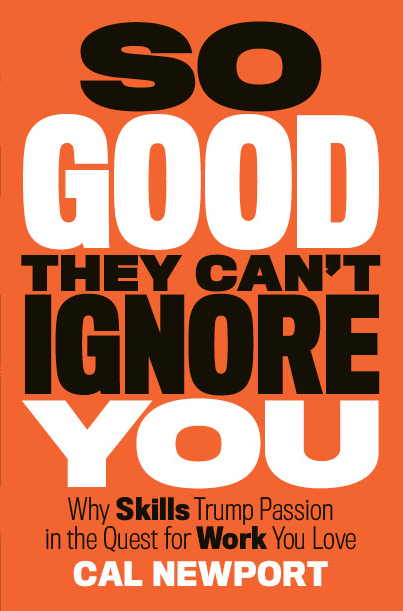
You may remember my blog entry "I'm lost. What's my purpose in life?" Cal Newport's book pretty much solves everything. I don't need to feel bad that I haven't found a purpose, because a purpose is only possible after I've spent decades developing valuable skills. My most meaningful career accomplishment will likely be something I never imagined.

I also noted that Cal Newport, being an academic, provided really really good advice for graduate students (and in general, anyone who is trying to create knowledge). I've already begun implementing his paradigm into my work (see below).

Below, I've copied my notes on Cal Newport's book. But seriously, go buy So Good They Can't Ignore You right now.
_________________________________________________________________________________

So Good They Can't Ignore You


Popular paradigm: look inward and decide your "passion," develop the courage to leave your job and go follow your passion. Then develop passion-oriented skills and do what you love.

New paradigm: Pre-existing passions don't exist. Even if they did, you would first need rare and valuable skills to back them up, called career capital, or you will fail. To find a compelling mission for your life, you need those skills first so you can explore many possible missions. You can develop career capital in nearly any job, because you can usually apply skills to other fields. Start NOW, in your current job. Careful: the more skill you acquire, the more others will try to convince you to help them or follow a traditional path, but stay focused on what you believe will make the most impact. Use your value to demand more autonomy and surround yourself with people you like and work well with. Then, use your autonomous time to develop your own missions. These are tentative missions - anything that seems interesting and important at the time. Your mission will constantly change, so be comfortable with it. Some missions will reveal themselves serendipitously- if you have the skills then you can take advantage of opportunities. Others will be brought to you because of your skills- people want to work with you. Learn as much as you can, brainstorm ideas, and put them into action in small projects. This will allow you to continuously expand, refine, or replace your missions until you believe that you are both working right and doing the right work.

Important: these are not a series of steps. They define a lifestyle. Different aspects are more important to focus on a different times. Career capital is most important for a 20-something, for example.

What Can You Actually Do Right Now?

Bold: Goals
Italics: specific activities that bring you closer to the goals. Do these on a regular basis.

General principles
  • Develop career capital - rare and valuable skills that make you so good/interesting that others cannot ignore you
  • Explore possible life/work missions - these will allow you to constantly refine your skill set, explore opportunities and develop a mission
  • Time tracking - track time spent towards high-yield activities, i.e. those that develop career capital and explore possible missions. These include deliberate practice and feedback, background research, little bets, serious study of others and others' work
  • Autonomy - YOU must make time for high-yield activities
    • Prioritize these over simple productivity
    • Turn down prestigious positions that saddle you with responsibilities
    • Surround yourself with likeable and talented people who respect your autonomy

Career capital
  • Identify rare and valuable skills that make the most difference in your current field or are generally applicable to any field
    • Study people who have rare and valuable skills
  • Develop rare and valuable skills:
    • Deliberate practice - strain yourself and embrace discomfort and ambiguity
    • Seek immediate, clear feedback, esp from mentor/coach

Mission and impact
  • Mission: Determine a tentative mission
    • Study people who have compelling missions and interesting careers
  • Cutting Edge: Do research and constantly scan for your field's next big idea - the "adjacent possible"
    • Background research: Learn new ideas in your field through reading, meetings, talks
    • Research Bible: Summarize idea-of-the-week in your own words
    • Idea notebook: brainstorm own ideas
    • Daily walk: free-form brainstorm related to the tentative mission
  • Little bets: small exploratory projects (<1 month) to test your ideas
    • criteria: must do at least one of the following:
      • force yourself to master a new skill
      • produce novel results
      • grasp the attention of others (i.e. be remarkable)
    • Seek concrete feedback, especially from others
    • obsess over self-imposed deadlines
    • publicize your little bets in a setting where word can quickly spread if the idea is good enough
  • Reflection: Evaluate concrete feedback from little bet, alter or replace tentative mission, guide further research, plan next little bet
    • Take 1 full day off per month for reflection


Friday, July 20, 2012

The future: no more secrets


The Internet lets people share the problems that are befuddling them. At the same time, the Internet allows for the dissemination of information for other people to solve those problems. And there's nothing stopping those people from connecting, other than the potential mistrust. I think one tantalizing idea is that we're moving towards a world where everyone (including companies) will share their information freely on the Internet. In other words, maybe everything will become open access. Nothing proprietary.

In the TED talk below, Don Tapscott tells the story of a gold prospector has collected a bunch of data on a geological site that he is evaluating. However, the geologists that he works with aren't able to locate the gold and aren't able to make recommendations as to where to start digging. So he thinks: maybe someone else would be able to figure it out. So he does something that is unheard of in business: he decides to publish his data online for everyone to see and held a competition for someone to locate the gold. The result? Someone found the gold, told him where to dig, and he made a bazillion dollars. Could he potentially have gotten scooped? Maybe someone would have sat on his result until the gold prospector gave up and sold his rights to the land, and then swooped in to grab the gold. But I think that's highly unlikely, since each person is competing against EVERYONE else on the Internet. If the malicious person decided to wait, then some other person would probably figure it out and then win his share of the gold in a FAIR manner. In this hypothetical Internet world where people freely share their "trade secrets," people who try to take advantage of other people will not thrive.


I think this is applicable to any field, especially science. If a PI needs something that doesn't exist yet but will likely require expertise outside their field, they currently have two options: hire a guy to work in the lab and develop it, or try to convince another specific PI to collaborate with them. The viability of both options is influenced by factors such as who is in your social network (i.e. having the right connections), investing time to find a person you can trust, and investing time to convince that person that it's a worthwhile pursuit. It's a lot of work and it is highly unlikely that you've found the ideal person for it, especially since you are not the expert and you aren't yet sure what is required to solve the problem. The biggest problem is that the PI is unlikely to disclose any detailed information about the project until he has found the person he wants to work on it. But this is totally backwards. You don't know if a person is going to be able to solve a problem until they've actually looked at the problem. Thus, if someone needs outside help, they can simply release all the relevant information onto the Internet and look for the guy who can solve it. Getting scooped is not an issue because everyone on the Internet already knows exactly what you did and what you contributed. (By the way, I think peer-review is going to get crowdsourced in the future, so it won't matter anymore who is first to publish a result in some paywalled journal). In this system, every professional scientist (or non-scientist, for that matter) could do a little science freelancing on the side, and personally I think it would be fun as hell. 

This also applies to companies. Right now, there's little doubt that the current pharmaceutical industry model sucks. What follows is a simplification, but one issue is that each company sits on a wealth of proprietary information but usually has insufficient power to utilize it. Note that these data sets are ASTRONOMICAL- drug libraries, clinical trial data, synthesis methods, preclinical data that shows that X drugs affect Y biological processes, etc. etc. There's no way that the employees of one company are going to use those data sets to their full potential. The companies are waiting for the chance to make money off of it, but because they have insufficient brainpower to tackle massive data sets, many drugs are not directed to their "ideal" patient populations, so many of the drugs fail. Plus, companies use the patent system to actively prevent others using that information, even if they independently discover it. And because the patent system is not perfect, everyone wastes time suing everyone else. Why bother with all the secrets? I think a lot more drugs would be successfully developed if every person in the world could look at pharmaceutical data and make their suggestions as to which drugs are promising for what diseases.

Remember, the goal shouldn't be to beat other people to the right answer. The goal is to find the right answer. Secrets were viable in the past because problems were simpler. Science didn't involve massive amounts of data. A small group of people could solve the problems without letting anyone else know what they're doing. But no more.

Please comment on my naivety.

Friday, July 6, 2012

Friday Links: DNA + dark matter, E.O. Wilson, skeleton racing

More Friday Links! 

A really cool research venture: using DNA to detect dark matter. Deep sequencing technologies require you to compactly array DNA molecules (all of different sequences) on a solid surface, and biologists have standard techniques (PCR + sequencing) to uniquely identify a DNA molecule from any given spot in the array. Guess what? That's a great setup for detecting dark matter. The hypothesis is that the Earth should be plowing through dark matter as it revolves and/or rotates, assuming that dark matter is diffusely distributed.

Essentially, here's how the DNA dark matter detector works:
1) Earth rotates, brushing through dark matter in a predictable rhythm that varies directionally throughout the day
2) DNA molecules are arrayed on a gold sheet. Dark matter can knock gold nuclei out of the sheet and into the array of DNA molecules.
3) The gold nucleus cuts a swath through the forest of DNA molecules, severing them
4) severed DNA molecules fall from the array and are collected, then amplified by PCR and sequenced so the biologists can figure out exactly which DNA molecules were severed
5) since they know where each DNA molecule was anchored, they can put together the path that the gold nucleus took
6) Match the path with the direction from which you'd expect the dark matter to be coming from at the given time of day.

One word: awesome.

E.O. Wilson, the famed evolutionary biologist who studies eusocial organisms, advocates the kind of cross-pollination exemplified by the above DNA-dark matter example. His message to scientists-in-training: learn broadly and collaborate broadly. Too many PhDs spend all their time doing experiments in a narrow field and never venture into other areas. But they are missing out: new discoveries are found in non-intuitive connections between different fields.

One idea I had relevant to MD/PhDs was inspired by E.O. Wilson's two strategies for doing good science:
1) Medicine shows the problems. Seek to learn all the problems (literally, ALL) then look for scientific phenomena that can explain the problems and provide a means to intervene
2) Science observes phenomena without necessarily knowing if they have consequences relevant to human well-being. Seek to learn all (literally, ALL) the phenomena then look for problems that might be linked to the phenomena and apply your knowledge to the problem

Every sport is a unique combination of agents (players + equipment) and rules that those agents follow (official rules + rules of physics). Fortunately, that's all you need to create a model of something, with the purpose of identifying the most important factors, and to predict and explain emergent properties.

Here, Freakonomics spotlights the Australian team in the skeleton, an Olympic sledding sport. They don't have career skeleton athletes (except one) and they don't have a chance to practice because, well, they're in Australia. You might think that the skill and practice time of the athlete are the two most important factors. In fact, that might be true in most sports. But if you carefully examine the rules of the game, you'll realize that there are two components to a race: the actual sledding, and the 30-meter sprint beforehand to get the sled going. Guess what? Australia has plenty of good sprinters. And as it turns out, using a little bit of modeling, you can show that the actual sledding is of minimal importance in terms of time. Skill might prevent you from wiping out, but as long as you stay on course you're not going to shave much time off with good sledding. So instead, they focused their efforts on finding really good sprinters and training them.

The result? An Australian qualified for the Olympics within 18 months, getting in about 1/10 as much practice time as a "career skeleton athlete." Very often, working smarter is 10x than working harder. Science knows best, and conventional wisdom fails miserably.

Haha all of San Deigo's July 4 fireworks goes off all at once:

Thursday, May 31, 2012

Veggies for non-hippies


Vegetables are a wonderful thing. It's hard to be satisfied with a meal unless it's chock full of them. One of greater freedoms of Ann Arbor is that one can be at Michigan's center of cosmopolitanism and fine culture one minute, and 20 minutes later (driving) be enjoying nature's peace of mind. I would've had to cross state lines back in Boston to do the same thing. In this case, nature is the farm that will grant me all my veggies for the summer. I've signed up for a farm share this summer, splitting it in half with my fellow MD/PhD student Ania. I participated 2 years ago and was deluged in earthly goods- some weeks I received in excess of 15 pounds. For those of you who don't know, a CSA farm is Community-Supported Agriculture (http://www.localharvest.org/csa/), where the idea is that you cut out the middle man, know your farmer, and know exactly where your food is coming from. From a more practical standpoint, you pay up front at the beginning of the summer (usually a couple hundred dollars) and get your vegetables in bulk each week for 18 weeks. It's enough for a family of 4 (which is why I split mine). The convenience is astounding- it's really easy to underestimate the time and thought spent at the supermarket selecting vegetables. The effort required in the aisles is just one more barrier to healthy eating, driving people to the pre-packaged food. Some weeks at the CSA you'll get 15 different kinds of vegetables all in one box, including ones you might have never tried otherwise. Great way to expand your palate without having to give it much thought.

This was the first week, early in the summer, so the harvest is only starting to pick up. It's mostly greens this week- later on there will be loads of squash, radishes, zucchini, bok choi, potatoes, spicy peppers, onions, tomatillos, basil, eggplant, melons and dozens of other kinds… heck there's even chocolate mint leaves. Since it was picked the day before or the morning of, everything has a wonderful earthy scent. The arugula in particular smells and tastes nuttier than anything I've ever found at Whole Foods.
A half-share of farm veggies. It's still early in the season so we're getting just greens- but there are some extremely large harvests to come! Top row: bean tops, mustard greens, chard, arugula. Bottom row: green onions, carrots, spinach, and a variety of herbs (chives, cilantro, lavender, sage, rosemary).
What will I make?
  1. salad of arugula, mustard greens, and chard
  2. stir-fries spiced up with some herbs, green onions, and beantops
  3. eat the carrots straight up
  4. GREEN SMOOTHIE from the spinach. I drink on average 1.5 smoothies per day, so my $10 personal-sized blender has seen a lot of action over the years. Peanut butter + spinach = heaven. Like most things in life, don't knock it until you've tried it.

Wednesday, May 9, 2012

Furious curiosity, mutagenesis screens, and prosopagnosia

And my blog returns! This is important to me because I'm trying to make writing a habit, since it stimulates thought. In the past it's been really hard to keep up new habits (even the ones I feel strongly about) but I'm slowly becoming better at it. So while this might be dangerous, I will go ahead and announce my goal: two blog posts per week for the rest of the month. No matter what.

You know what else stimulates thought? Talking to people in completely different fields than your own. I just had a really good 45 minute conversation with a fellow patron at the Espresso Royale cafe. He's a humanities grad student, so given that I'm an MD/PhD student in biogerontology, it shouldn't be surprising that it was pretty varied in terms of topic (really interesting topics, to me anyways). One might think that because neither of us knew that much about each other's fields that the conversation would be superficial. But that's not what happened. I think that because we both approached the topics as beginners, our minds were working with furious curiosity, and the ideas just started flowing. Soon enough, I was explaining the nuances of the evolutionary theory behind lifespan determination, as well as how to calculate the chances of double hits in C. elegans mutagenesis screens. He understood the intuition as well as any scientist. Meanwhile, I was also taking in ideas on the influence of postmodern thought in the humanities, the origins of musical genres, and public choice theory. I ended up sometimes sticking scientific labels on things, like emergent properties and Heisenberg's uncertainty principle, but that only goes to show that the tools and concepts of one field equips you to understand other fields (cross-pollination :) ). Conclusion? The position of a beginner may be an uncomfortable place, but it's a fantastic place to grow.

Speaking of mutagenesis screens, tomorrow I get introduced to another high-throughput method in the C. elegans roundworm. I will be trying out a BioSorter, which is capable of sending worms (or zebrafish, or fruit flies, or clusters of mammalian cells) through an analyzer that can assess size and fluorescence and count and sort them (i.e. exactly like flow cytometry and FACS). Handy tool for handling large numbers of animals and systematically searching for manipulations that impact the biological process you're studying (e.g. aging).

Finally, I'll leave you with a couple of cool facts from the last book I read, The Best American Science and Nature Writing 2011, which is a collection of essays from all scientific fields (environmental science, astronomy, physics, biology, medicine). One essay by Stephen Hawking. My goal is 20 books by the end of the year, which I'm tracking on Goodreads, a social book site where you can see what your friends are reading.
1) About ten million songbirds (warblers) are killed each year in Cyprus by poachers. They are served as a delicacy called ambelopoulia. Lots of other birds can caught in the process and are simply killed. The poaching is technically illegal, but the law is minimally enforced (even prominent politicians will eat it on camera). Most interestingly, because it is illegal, most of the poachers are armed criminals somewhat analogous to drug cartels, so police officers are wary of going after them. Another example of how banning something doesn't necessarily help a situation, but instead creates a black market that is unregulated.
2) A black bear must consume 200,000 calories per day in order to have sufficient fat stores for winter hibernation.
3) Laysan albatrosses have permanent mating pairs and together nurture an egg each year. They don't stay together throughout the year but somehow manage to find each other again when mating season arrives. About 1/3 of the "mating pairs" are actually female-female pairs, as both females are fertilized by a quick mating with a male from another pair.
4) Prosopagnosia is a specific inability to recognize faces and places (agnosia is the more generalized inability to recognize objects). Usually individuals have lesioned fusiform gyruses, either by trauma or by some sort of genetic variation (some cases run in families). People with prosopagnosia usually develop tricks to get around it, recognizing other people based on gross features or context. It is believed that this is much more common than one might think, as people don't seek medical attention if they are born with it, because "that's just the way they are."
5) Kessler syndrome is the official name for the "space junk phenomenon," where it's getting increasingly dangerous in near-Earth space because of a bunch of aging equipment we've left there. The issue is that a single collision between two objects will create thousands of smaller objects that are equally dangerous, creating a catastrophic domino effect. Because of the velocities involved, one of these tiny fragments would be like a truck bomb. A 10-cm sphere of aluminum packs the punch of 7 kg of TNT.

Saturday, May 5, 2012

Blog launch; people aren't that racist

Hello! I heard it's a good idea to have a (flexible) purpose in mind when starting a new venture, so here are my reasons for starting a blog- I suspect these are common to many bloggers.
1) Share things I find interesting. Usually these involve things that defy conventional wisdom (e.g. segregation, see below)
2) Share things I'm working on to improve myself. Writing it out helps me think about it, keeps me honest, invites feedback, and maybe gives others some ideas. I have so many general goals, such as reading more, keeping a diary, getting comfortable talking to strangers, pre-defining my goals for the day/week/month, etc. But I hope that having a defined task such as a blog entry will help motivate me.
3) Improve my writing skills and stimulate my mind. Pushing myself to generate interesting blog posts will force me to look into things I'm unfamiliar with.
4) Eliminate any residual fear of having my ideas be judged by others.
So, now see below for my first real blog post!
__________________________________________________________________
Intro
In my free time I've been looking into the recent explosion of startups and non-profits offering online courses, including Coursera, Udacity, and edX. These offer full-semester-long courses, given by full professors at top colleges, complete with lectures, quizzes, problem sets, and final exams, and available to everyone for free. I'd argue these are going to be a lot more effective than traditional classroom learning, where half the students are on the Internet anyways NOT learning.
So right now I'm taking Model Thinking on Coursera, and I'd have to say the interface is a lot more engaging than the majority of in-person teachers I've had. The course is a personal project of Scott Page, a professor at the University of Michigan. And it's not just a video of the courses he normally teaches- you can see him directly talking to you, his pre-prepared slides, and the stuff he writes on the slides as he talks to you in real time. And yes, you can speed it up (2X max).
I hope that Model Thinking will help me think as a scientist and an intellectual, rather than just as a worm geneticist. I also like that models can lead us to unexpected conclusions, so I will share one of the first models presented in the class: Schelling's Model of Segregation.
The model
The question behind Schelling's Model of Segregation is: We all know that many (most) cities in the US are highly segregated, along lines of race, income, etc. Blacks might on average have 80% black neighbors, while whites might on average have 80% white neighbors. Why? Is it just because they are racist and like their own kind? You might think that if people want 80% of the people near them to look like them, and people are freely moving, then on average people will have 80% of their neighbors look like them. But let's do some modeling.
We have X number of people in a hypothetical city, and a grid of X homes that they can occupy. Each person is given the choice to move or stay, based on their neighborhood percentage of people who look like them, call that P. Let's say they will move to a new home if P is lower than a threshold T. In the real world, this means a person looks at his/her own neighbors, and gets a little spooked by the number of people who don't look like them, and moves. This is applied iteratively, since as one person moves that might cause others to move as well => this is a simulation.
Let's say that T is 30%. In a city of half whites and half blacks, that in fact is very much UN-racist. In fact, they would tolerate being in the MINORITY in their neighborhood. People only need 30% of their neighbors to look like them for them to stay. If you run the simulation (use a computer program), what do you get as the end result? >75% segregation. In other words, on average each person has 75% same-race neighbors.
How can this be? We already said that people don't mind being in the minority, and they are at most minimally-racist. How did we end up with major segregation without any other factors at play?
If we think carefully about the model, there are two tipping points that bias in favor of segregation. Essentially, the effect of any one person moving gets amplified.
  1. Exodus Tip: A person moves out of a neighborhood. For their original same-race neighbors that may decrease their percentage below their Threshold T. For example 3/8 > 30% becomes 2/7 < 30%.
  2. Genesis Tip: That person moves into a new neighborhood. For their new different-race neighbors, that may decrease their percentage below threshold T. For example 2/6 > 30% becomes 2/7 < 30%.

These are kind of common sense, but it's hard to fully appreciate the domino effect this can have.
Once one person moves, another moves, then another moves. The end result is segregation. In fact, if we only have the requirement that people don't want to be in the minority, i.e. people only want at least 50% of their neighbors to be of the same race, what happens? The end result is that 90% of a person's neighbors ends up being of the same race.

Finally, the kicker. What happens if people ARE really racist? What if they have a requirement that 95% of the people near them have to be of the same race? Here's another thing that completely defies conventional wisdom: you DON'T GET SEGREGATION!!

This blog post is getting long, so I'll let my readers figure out why HIGH LEVELS OF RACISM leads to situations where there is NO SEGREGATION.

Anticipated rebuttal

I'm sure you have a rebuttal to all this. That there are many other factors at play that might allow racism to be the primary explanation for segregation, i.e. racist laws, rent, gentrification, etc. Fair points- it is POSSIBLE for racism to explain segregation. But it is still valid to say that just because there is segregation arising from individual behavior, we shouldn't assume that individuals are racist.

Furthermore, this highlights the importance of models. This model left things like rent and gentrification out of the equation. It made some assumptions that may not be entirely true. But all that is besides the point. The act of laying out assumptions and taking them to their logical conclusion helps us think about a problem. In the end, we may end up keeping or throwing out some of our assumptions, and deciding that we need more data on the things we left out of the model. And in the end, we're all the better for it. We made progress.

___________________________________________________________

Conclusion

I hope that the models I learn the Model Thinking class will be fertile, i.e. they will be applicable to biology and medicine even though many of them were developed for economics and social science. A PhD is a fantastic time to explore all sorts of things that interest me and develop a variety of skills, because I have control over my own time. This will be an adventure, and I hope you'll join me.

About Me

MD/PhD student trying to garner attention to myself and feel important by writing a blog.

Pet peeves: conventional wisdom, blindly following intuition, confusing correlation for causation, and arguing against the converse

Challenges
2013: 52 books in 52 weeks. Complete
2014: TBA. Hint.

Reading Challenge 2013

2013 Reading Challenge

2013 Reading Challenge
Albert has read 5 books toward his goal of 52 books.
hide

Goodreads

Albert's bookshelf: read

Zen Habits - Handbook for Life
5 of 5 stars true
Great, quick guide. I got a ton of work done these past two weeks implementing just two of the habits described in this book.
The Hunger Games
5 of 5 stars true
I was expecting to be disappointed. I wasn't.

goodreads.com