Today is a ridiculously busy day. I still need to prepare my lesson for teaching at 1pm, and today is one of the few days this week that harbors a continuous block of time to get lab work done. And I want to read some papers and get some planning done. And all this needs to be done before I pick up the guest I'm hosting for PhD recruitment weekend. Since I need to take him around campus tomorrow to all his interviews and events, I won't be able to do much tomorrow other than grade papers and maybe read my 5th book. Anxiety is rising.
But I'm taking a little time to slow down and gather my thoughts for this morning on this blog. I went down to the cafe, selected their newest roast, and sat down in the comfortably spacious common area. I suppose I could've looked out at the heavy snow and temperature drop from 50 to 20 degrees as a frustration and a blockade to productivity. But I'd rather gaze out of the big bright windows, see the beauty from my warm chair, and purposefully enjoy my coffee. I let my mind settle on comfort and charm of Ann Arbor and the feeling of being at home. Simultaneously, I wonder about everything else out there on this planet and all the experiences awaiting me in life.
I like slowing down at the beginning of the day. It is all too easy to see one's massive to-do list and rush straight into work. But paradoxically, this leads to less work getting done. It's hard to focus on one's work if you just think "I have to do this today," rather than "I want to do this today." It's hard to be creative unless your mind wanders a little and brings new resources to bear on the problems you're solving. And without taking some time to think, it's easy to fall into the trap of doing urgent stuff, rather than important stuff. And that is a form of procrastination far worse than delaying your work for 30 minutes.
Since sitting down, I've determined the #1 thing I need to do this morning is perform a literature search and determine the list of gene expression assays I want to design. Then, the #2 thing I need to do is plan my teaching. Also, I need to go to the gym since I won't be able to go later. Exercise is not something I'm willing to compromise on, no matter how I busy I am. That's it for this morning until my discussion section. Nothing else will enter my mind.
Taking some time to prepare the mind will cause one's most important priorities to float to the top, where they are ripe for picking.
High-Yield Practices to Prepare Your Mind
Sometimes one can get up without direction for 30 minutes and stumble upon an idea or practice that changes one's life. Not likely, however. Some default choices for what to do to gather one's thoughts for the rest of the day:
Create.
I created this blog entry this morning. Write, build, draw, create a connection with another human being.
Focus on a simple joy.
Just for a few minutes, nothing else in the world can get between you, your cup of coffee, and your thoughts.
Exercise.
Work hard enough to feel discomfort. Embrace the discomfort- that attitude makes you feel ready to tackle challenges for the rest of the day. Eat some protein afterwards.
Make something sparkly clean.
But don't rush it. Consider your environment's effect on your mind.
Read something unrelated to your work.
Try to learn a new idea. Or engage yourself in a new story. Important: Don't read the news.
Generate ideas.
Doesn't matter how stupid they sound. Write them down. Create. If nothing comes to you, read something first and really consider it. Anyone can become creative if they practice being creative.
Finally, after you're all done, either plan the rest of your day, or go straight into your #1 most important and most difficult task of the day. Look at it as an opportunity.
Showing posts with label sustainability. Show all posts
Thursday, January 31, 2013
Wednesday, September 26, 2012
My Gamified Life: Fitocracy
I mentioned in a previous post that I've made it a habit to exercise, and so I don't have to expend any mental energy to get myself there (I have plenty of other things on my mind). But I think the best way to keep a habit is to make it FUN, each and every day.
Gamification: It takes tremendous self-discipline to motivate oneself today based on some imagined/abstract healthy future. Instead, the best way is to INCENTIVIZE yourself on a day-to-day basis to exercise. Now, having society pay people to exercise would be impractical. But remember: a huge number of people play Farmville and World of Warcraft for days non-stop just to win virtual points. The incentive is further reinforced long-term by mechanisms such as leveling up, completing quests, reaching achievements, and receiving virtual tokens of support from friends. Incentives can be entirely virtual and cost nothing. Microsoft got its employees to volunteer their time to find bugs in Windows 7 by giving them virtual points People did a mind-numbing task (finding software bugs) over and over and over without pay, just because it was fun to get virtual points and compete against other employees.
Guess what? There IS a website that gives you points for working out, gives you fitness quests RPG-style, and lets you socialize all at the same time. I've been using Fitocracy since November 2011, and I think it's crazy everyone isn't using it.
The beauty of Fitocracy is the combination of two features:
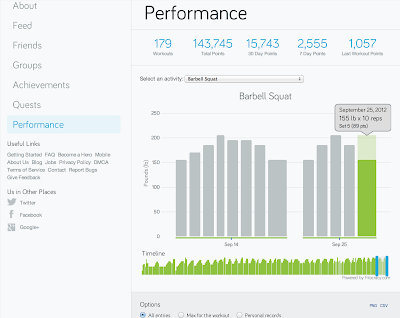
1) Incentive system that lets you track your progress. This is simply fun. During my workout, I use the iPhone app to easily enter in my exercises as I'm doing them. At the end of the workout, it rewards points based on the type of workout, the # of reps, and the # of sets (generally, points are compound lifts > isolated lifts > cardio). I automatically get a good sense of how much I accomplished, and I feel like I've earned something. I don't think twice about working out. After you accumulate a certain number of points, you level up. People give each other "Props" just like Facebook's "Likes." There are also quests and achievements. As further encouragement, it automatically graphs your progress on each exercise for you.
2) Social network. Fitocracy boasts about 230,000 users, and many of them are fitness enthusiasts and personal trainers (and a disproportionate number of cardiologists and orthopedic surgeons). And yes, lots of nerds too. You can easily find people who match your fitness interests. Many of them post pictures of themselves (i.e. before and after transformation) so you can see what kinds of results they're getting. You can see EXACTLY what exercises they do down to the last detail. Got a question for one of them? Need advice? Just ask.
| Typical workout entry |
These two features synergize. For example, Fitocracy has a universal set of "Achievements" that anyone can obtain. These are things like "Bench press your body weight" or "Deadlift 2X your body weight" or "Run 200 miles total." For the longest time, I was in awe of other people with the 15-pullups achievement- I started out just struggling to get the 5-pullups achievement. In the back of my mind I thought "well I'm not THAT intense- and probably won't ever get there." But then I read one profile and figured out how quickly that person went from 3 to 15 pullups… and it was less than a year. And what kind of motivation do you think I got when I achieved it last month? The habit is self-perpetuating and only gets stronger over time.
Myths: Just talking to more experienced people on Fitocracy is a great way to re-educate yourself. There's a lot of fitness controversies out here, but here are some myths that are pretty much completely debunked:
1) "I don't want to weightlift because I don't want to get bulky- I just want to get toned". OK it takes many years for a guy to bulk up lifting weights every day (unless they take steroids- not recommended). How long do you think it takes for a woman who has >10X lower testosterone? Women will slim down with weightlifting because muscle takes up a lot less space than fat. If you take 10 minutes to look around Fitocracy, you'll rapidly find dozens of counter-examples to the bulky myth (like this and this). The bulky women you see in magazines are either on steroids or are in the <5% of women who have naturally high testosterone.
2) "Deadlifts are bad for your back, and squats are bad for your knees." I used to get back pain and it's completely stopped since I started doing deadlifts. I used to get knee pain if I ran too much and now it's never a problem. You can only injure yourself if you have bad form, and Fitocracy lets you talk directly to other people (like personal trainers) about your form. Some people even post videos of themselves so others can critique them.
3) "Everyone needs cardio." Only necessary if you have a family history of heart disease or if you're training for a sport that involves a lot of cardio. Weightlifting is enough.
4) "Situps reduce belly fat." Actually, probably the best way to reduce belly fat (or any type of fat, because spot reduction is impossible) is squats because maintenance of the big muscles will divert energy from your fat reserves.
5) "High-protein diets kill your kidneys." It increases your kidney blood flow, working it harder, but that doesn't mean it's damaging your kidneys. Think of it as exercising your kidneys. Sure, people with kidney failure will worsen it if they eat more protein, but that's no different than trying to lift heavy boxes immediately after breaking your leg.
I think we're entering an age where traditional sources of information like fitness magazines and celebrity workouts have pretty much lost their value compared to just talking to other regular people like you and me who have made real progress. If you look in magazines, everyone is airbrushed and all the men are on steroids, and they don't do anything but work out. You have no way to verify the information they give you. On Fitocracy, you can see literally thousands of actual success stories from people who are just as busy as you. Along those lines, Reddit Fitness FAQ is also an excellent source of information.
Here's my shameless invite link.
| Track your performance over time. |
| iPhone app |
Thursday, September 20, 2012
Work is Play: Stop focusing on your job's relevance
Recently, I've been reading the autobiography of Richard Feynman, the Nobel prize winning physicist. He reveals that after working at Los Alamos developing the atomic bomb, he fell into depression and a creative rut. One day he decided he was going to stop focusing on solving problems for societal benefit, significance, or any other purpose. He would simply play with science. He would work on the quirkiest problems, without any regard as to their relevance. One day he saw a colleague throw a dinner plate into the air and noticed that the ratio of the wobble to the spinning appeared to be 2:1. So he spent a huge chunk of his time trying to work out equations for it. Guess what? It got him out of his rut- he stopped caring that others might be judging him for spending his tenured faculty time on silly things. He could just dive in and think about the physics. And the equations he worked out happened to describe an analogous phenomenon in quantum mechanics, forming the basis for his Nobel Prize.
I entered my PhD fascinated by the basic biology behind aging and its implications for society. I preferred thinking about science in the abstract rather than the labwork which I saw as hard work, a necessary evil. A lot of protocols are mindless because they are so well established- you just have to do them as manual labor. Early on I made a lot of mistakes in lab. It was very slow and I found myself procrastinating on my project, even ignoring reading papers because it would just stress me out by reminding me of labwork. Feedback loop initiated: I felt overwhelmed by how much stuff I needed to do, and I felt bad that I seemed so behind, especially compared to other people. Whenever I did make progress, the solution was so simple that I found myself regretting and blaming myself for not doing it earlier. So I started procrastinating even more.
But certain forms of procrastination are ultimately beneficial.
One purpose of this blog is to carefully consider and publicize my efforts to make deliberate changes in my life: One common question I get is, "how do you have time for blogging? Or any of this??" You could also ask how I have the mental energy for any of this.
Yes, that is the PhD. I get to choose how I spend all of my own time. Some scientists think as a PhD student you should be focused so much on your scientific work that you don't have time for anything else. I disagree. I think you should be dedicating all of your time to training yourself to be the most effective intellectual possible. You have to figure out for yourself how to do that- there are many avenues that don't involve working.
- Stopping myself from wasting time on the Internet? A no-brainer.
- Managing negative thoughts? Your self-talk can be a massive hindrance to your productivity.
- Fitness? Exercise grows new neurons in your hippocampus, prevents depression, and improves cognitive function.
- Learning other subjects? I solved a major problem in lab by analogy after reading the blog of someone describing an entirely different problem.
- Practice writing? Last year I was really really slow at writing analysis papers for classes. When it comes to publishing, I can't let being out of practice get in my way.
- Trying new things? If you can get yourself in the habit of jumping into things you know nothing about, you will have no problem getting started on that new method which will yield the best data.
- Idea generation? Good ideas in science are a needle in a haystack. But if you don't have a haystack in the first place, you won't find the needle.
Hence, everything I am doing outside of lab IS contributing to my PhD work, by investing in my most precious resource: myself. Doing these things takes time and focus. By focusing on side projects OUTSIDE of work, I was able to get started without any of the negative feelings about my work. Like Feynman, I stopped caring about what I was "supposed" to do- and that enabled me to just get started.
Changing myself has changed the way I look at my work.
Sure, I still don't gain any enjoyment from the physical act of conducting wetlab experiments. But one habit I've formed is to ask myself: What do I actually enjoy? What could I actually enjoy about my work?
- Figuring stuff out
- Talking to others and coming to a revelation together
- Control over my own time
- Trying new things
By mentally focusing on these things in lab, I enjoy my work way more even if there are aspects that I'm still impatient with. Nowadays, I tend to push the mindless protocols to the end of the day and just listen to the Daily Show or podcasts in the background. I'm relaxed. No longer are they a problem.
I really started only addressing this in earnest this month. When I started focusing all my efforts into lab and nothing else, I almost gave up. Negative thoughts returned, I felt overwhelmed and regretful that I "wasted" time on all these side projects. But my focus kept up and survived, because I had trained my own brain this past summer on those very side projects.
Now I'm working way more hours in lab than ever before and every moment of it makes me happier- all because I changed the way I look at my work. When I need a break, I take a break. But I've discovered it's possible to make working extremely long hours sustainable- but it requires effort to restructure your mind so that it is sustainable.
When Richard Feynman was a child, he spent most of his time playing with science, building quirky ideas in his makeshift lab. While studying college physics, he conducted elaborate experiments on ant behavior, even though they had no relevance to physics. But by making work into play, his crazy-busy career became sustainable for him. It reminded me of one comment on my 1st grade report card: "He loves playing with math. He loves playing with science." 1st grade me was pretty wise- I have much to learn from him.
Sunday, July 1, 2012
June review, July goals, and sustainability
It's July 1, and it's time to do my monthly review! Specific goals for each month, and be honest with myself about how I did and how much more I can take on. As a reference, here are my June goals.
June
The name of the game is sustainability. Sometimes sustainability can be achieved in non-intuitive ways. For example, in a previous post I described how I was going to warm-up at the beginning of idea sessions by doing a 5x5 idea list (based on things I should be thinking about everyday anyways) before my "real" idea list of the day. While this sounds like way more work, it actually results in finishing my idea habit in LESS time and thus is MORE sustainable. Since I've implemented it, I've never had trouble finishing my idea habit within 30 minutes (including associated reading). And that's because it just gets my brain working on actual ideas rather than worrying "is this going to be a good idea list?"
I work out almost every day without needing to give it a second thought. It's just part of life. I have no problem dropping everything at any given time of day, changing, and running to the gym. This is exactly what I imagined doing with my June goals. The entire point of doing a 30-day trial where I focus intensely on a handful of goals is to overcome the activation energy barrier, and then I can keep doing it without using up mental willpower. In particular, generating ideas and reading the scientific literature on a daily basis proved to have just as much utility as I had originally imagined. Thus, I have a conscious motivation to keep doing them. I just needed to get started. Furthermore, I've simply become used to doing them, and quite possibly I've become emotionally attached to them (in a good way). Once this happens, not only is it easy to continue doing them without all this deliberate tracking, but I subconsciously feel like something is wrong if I haven't completed them yet on a given day. Thus, it is sustainable.
I will continue idea generation and reading, but I won't be tracking them daily.
I'm much happier with my goal of waking up at 6am than the graph would suggest. I've been tracking my goals in a binary fashion- yes I woke up at 6am, or no I didn't. But simply focusing on waking up earlier has helped me stop wasting time at night and just get to bed, and I have more willpower to get my butt out of bed. Hence, my average waking time has shifted from 9:30am to 7:30am, and that has been great for productivity. I used to think I'm not a morning person, using that as an excuse not to wake up early. Boy was I wrong.
July
Conversely, while my "Lab Plan" goal looks like a success on the graph, there was way too much stuff for me to juggle in lab to really plan anything long-term (to remind you, I'm already pretty happy with my ability to plan within a day). While I worked on my Lab Plan most days, it never made any real impact because it was too unfocused.
Fortunately, my research project has gotten to the point where I just need to hammer out and repeat a series of known experiments. The essential story and elements of a publication are all present, and we've decided to scale back some of the more interesting but technically difficult experiments, and save those for a second publication. Hence, July (and August) is going to primarily about getting all these experiments done, and I'm going to focus my Lab Plan on just that. 3 MIEs (most important experiments) per day planned out for the entire month, and stick to it.
This month there's not going to be much time to develop new habits and work on other goals outside of lab. If I take on too much, it will no longer be sustainable. However, I feel like I should solidify one skill into a daily habit: writing. My goal is to write 30 minutes per day, and much of this will be my paper, though some of it will be my blog. There's no reason to have 100% of my experiments done before I start writing a manuscript. Some days I will write more, for example on days that I'm publishing this blog, or simply whenever I have the time and the ideas.
However, I would go crazy if I did nothing new. On this point, to hell with sustainability. (By the way, this isn't really a habit but an attitude: I generally try something new everyday). This may seem random, but I'm going to learn the Python programming language and find ways to use it in my work. I have some experience with Java but as far as I can tell Python is easier and more intuitive. I'll probably start with some csv files and use it to convert experimental data from one format to another, something that I've been doing manually by copying and pasting. If anyone has any ideas on how I can use Python in my work, please let me know.
To summarize, I have 3 primary goals for July.
1) Lab plan. Plan out experiments long-term rather than just daily. Primarily just experiments related to a publication (hopefully!)
2) Write 30 minutes per day
3) Learn Python. Each day, work on it until feel like I've learned or done something interesting. Time limit 30 minutes per day unless I'm applying it to work.
Subscribe to:
Posts (Atom)
About Me
MD/PhD student trying to garner attention to myself and feel important by writing a blog.
Pet peeves: conventional wisdom, blindly following intuition, confusing correlation for causation, and arguing against the converse
Challenges
2013: 52 books in 52 weeks. Complete
2014: TBA. Hint.
Reading Challenge 2013
Goodreads
Albert's bookshelf: read
by Leo Babauta
Great, quick guide. I got a ton of work done these past two weeks implementing just two of the habits described in this book.