Showing posts with label monthly review. Show all posts

Sunday, September 29, 2013

My Most Productive Month Ever: Some Secrets

Hi all! Just a quick update. This has been my most productive month yet (in my life), so I'll share my thoughts.

Back in June, I wrote a lot about:

1) working on my most important projects in focused, distraction-free 90-minute intervals
***2) batching together less-important tasks so they don't become distractions while I'm trying to get actual work done
3) preserving time for daily habits

Since my last post, I've taken #2 to an extreme, through a process of experimentation. I also have updates on #1 and 3, but I will save that for a future post.

The result can be summarized as three rules:

Rule 1: Schedule as many small tasks as possible on "Batch Day"

Batch days are perhaps the most useful innovation in my schedule. I pick the day of the week I have the most meetings/appointments and tell myself, "I don't need to make any progress on my research that day." Instead, I get all of the little things I need to get done out of the way for the week. This includes personal errands: laundry, clearing out my e-mail, shopping, cleaning, organizing, bills, etc. It also includes all the little tasks around lab that I need to do on a regular basis, favors I need to do for other people, and generally any task that takes time and energy but not much thought.

Essentially, anything that does not move my project forward gets stuffed into this single day per week.  These days end up being PACKED and I have no trouble exhausting myself by the end of the day. I usually don't finish everything, so I end up doing some "batch" tasks towards the end of other days of the week.


My time tracking for moving my project forward vs. all other tasks. Note that I only mark down time in which I am fully focused on the task at hand. Just being at work does not count for anything. My philosophy is work harder, not long.
This is intended to avoid letting these small tasks interfere with my research. They are extremely dangerous because they feel like productivity, so they can easily be used as an excuse to avoid making progress on my projects. Whenever such a task gets presented to me during the week, I put it on the list for my next batch day (which may be up to 6 days later) and go back to work. I only do the task immediately if it takes less than 2 minutes or if it is extremely urgent.

Unexpectedly, I'm now far more on top of my responsibilities than I was before. Because one day per week is specifically designated for small tasks, I rarely procrastinate on them. When someone asks me for something, I can tell them I will do it next Wednesday. And it's easy to deliver.

Rule 2: Schedule meetings only for the busiest day of the week.

Look at the schedule below. If someone wants to schedule a meeting, I will reply as follows:
"Thursday is best. If that doesn't work, I might be able to do Monday at 11am or 1pm, or Tuesday at 8am."


To concentrate on my work and do it right, I need long stretches of time to focus. Therefore, Wednesday and Friday in the schedule above must be protected at all costs. Switching between projects or tasks is the best way to lose time in the day.

Rule 3: Check priority e-mail once a day after finishing my work, and the rest of my e-mail once a week.

Checking e-mail is the best way to lose focus. Therefore, I designate a specific time in the afternoon AFTER I've finished my most important tasks for the day to check e-mail. Even then, I only look at and respond to things that make it into my priority inbox. Once a week, usually on batch day, I will quickly process my e-mail and reach Inbox-Zero in about 30 minutes (including responses and small to-dos).

On processing:
I never leave an e-mail in my inbox after looking at it. I immediately do one or more of the following:
     1) delete it
     2) archive it
     3) add event to my calendar
     4) add task to my to-do list (usually on my batch day list)
     5) write a note to myself and file it properly
     6) respond as succinctly as possible

Monday, June 24, 2013

June Review: Results and hard work are mutually exclusive

It's already time to reflect back on the entire month.

I was healthily hypomanic for the first two weeks. My willpower and confidence was through the roof- I felt like I had the discipline to break through any obstacle. And indeed I did. I easily wrote off thoughts of other's expectations (does X person expect Y from me right now?) and was able to focus on what I thought was most important.

I didn't get much stuff done in lab this past week. Most of what I did do failed. I'm OK with that. I was trying to accomplish a lot before next week's International Worm Meeting in LA, but I think ultimately my brain told me I didn't have enough time to do everything I had planned. My brain felt saturated- by everything I wanted to do, AND everything I thought others expected me to do. I took Thursday off to run some errands and read, and that was easily the best decision of the week.

My time is now constrained- I leave for LA on Wednesday morning, and I still need to make my two posters for the meeting and take care of some obligations. Not to mention do laundry and pack. So I have little doubt that today and tomorrow will be a productivity bonanza.

Then the upcoming Worm Meeting is the perfect chance to incorporate everything I've been working on these past few months- interviewing successful scientists, my first manuscript, practicing eye contact, teaching, literature reading, my current projects, and gathering ideas for the next phase. It has the potential to concretely advance my work in a measurable way. Time to level-up.

_________________________________________________________________________________

Embrace the Cycle

There is a clear cycle at work here. When I started this month, I thought I'd be working hard every week and be relentlessly results-focused the entire time. That's what I had developed my scheduled bursts for. But hard work is NOT the best time to get results.
  • Phase I: Perspiration. Work intensely to the point of discomfort. Acquire new skills and try new things. Ignore results.
  • Phase II: Rest. Mental distance. Do something else, and don't worry about your work.
  • Phase III: Level-up. Concrete progress. Demand results from yourself.
Phase I vs Phase II: Progress takes discomfort and hard work. There's no way around it. But that sort of mental training is impossible to maintain. As biological creatures, we need Phase II- time to rest and let our bodies and thoughts reorganize themselves. 

Phase I vs Phase III: One should NOT be results-oriented during the hard training phase. Obsessing over concrete results leads us to take shortcuts and take solace in easy and ultimately unimportant accomplishments, because it is impossible to make meaningful gains on a daily or even weekly basis. Instead of focusing on what you accomplish, focus on how you work. Refine your process and treat it like a craft. Once you have built a solid base, then you can later apply them to getting results.

Phase II vs Phase III: Phase II gives you the time to consolidate your newly acquired capabilities and build up your mental energy for the final push for results. Then, you can tell yourself during Phase III that you WILL do something amazing, and this brings the exhilaration and adrenaline required for a truly meaningful accomplishment.


The entire perspective of this post was inspired by weightlifting. My weekly workouts cycle between  intense training, a light workout, and a PR day. Analogies are awesome.

_________________________________________________________________________________

Just because I promised it

No schedule for the upcoming week, since it will be inherently dictated by the Worm Meeting schedule.

Green blocks are successful scheduled bursts, red blocks are failed, and blue blocks are prior commitments.


Sunday, June 16, 2013

Weekly Report: Discomfort Solved

This was a very interesting week to start my experiment, because I bought a condo! That obviously took a lot of time, and I faced some other personal challenges this week as well. But my scheduled bursts still allowed me to get a lot done, and my habits have taken a lot of the stress out of my life.

If you haven't read up on my new system yet, see my last blog post.

See after the calendar for the lessons I drew this week.

Report (see calendar): I met my scheduled bursts (green) on Monday, Tuesday, Friday, and Saturday without much trouble. However, on Wednesday (yellow) I had an urgent interruption related to the condo, so I simply did my burst later in the day, under non-ideal (i.e. distracted) conditions. On Thursday (red), I was simply exhuasted from the condo closing and decided to take a nap instead. Yes, I would call that poor planning, and in the future I will avoid planning bursts on days surrounding major events.
Green = success. Yellow = urgent interruption. Red = failure. Blue = other commitments.


__________________________________________________________________________

My new favorite thing: discomfort

But overall, I got a lot done this week. I tackled two big experiments that I had been putting off, partially because of lack of time, and partially because I was a bit fearful and didn't know where to start. However, just 1 hour of focused concentration in each case proved sufficient to break through the barrier. At the beginning, I felt stupid and perhaps a bit guilty. After that very uncomfortable hour, I knew what I needed to do, and I was able to get started on real work. And I managed to get real (and exciting) results for both of them.

This illustrates what I've known for a while, informed by bloggers like Cal Newport and Scott Young: 

~Comfort with discomfort is one of the most important skills a person can develop. Forcing yourself to persist through discomfort is critical when starting any new project. Otherwise, it is too tempting to go back to easy work that only makes you feel productive.~

Scheduled bursts are a great way to force yourself to embrace discomfort. They are time-limited, so the task no longer seems as daunting and it's easier to get started. The process of systematically eliminating distractions also helps to psychologically prepare you for the discomfort.

To facilitate getting into "the zone," I have implemented a checklist for when I start these sessions. Checklists are obviously ubiquitous, but I'm using them for two very specific reasons:
1) Mental attention: It gives my mind one less thing to keep track of. Making deliberate changes to one's productivity system itself requires mental attention, and checklists lessen that requirement. The checklist makes it easier to fully focus on the task in front of me.
2) Ritual: This tells my brain that it's time to enter a state of "deep work."

My checklist for scheduled bursts.

__________________________________________________________________________

Habits are investments

I won't comment much on these this week. But I've observed two things:
1) I've already begun noticing changes in how I perceive events and how I interact with people. In particular, I make much better eye contact and feel much more confident.
2) These habits are now always running in the back of mind. Thus, I can automatically activate them when appropriate.
Lift habits.

__________________________________________________________________________

Next week's schedule

I also noticed last week that front-ending my bursts (e.g. scheduling more towards the beginning of the week, and beginning of the day if possible) makes good use of my abundance of early-week energy. It also eliminates feelings of guilt if I have to tend to other things later in the week. This week, I have to front-end my schedule, since I will be away for a wedding Friday-Sunday.

Scheduled bursts are in orange. Other commitments are in blue. Everything else must fit into the white space.

Monday, June 10, 2013

June plan: Scheduled bursts and worthwhile habits

Last time I described my goal of combining two productivity regimes: drip and burst.

To recap, the hybrid approach has three levels:
1) pre-scheduled bursts of intense, focused and distraction-free work on my most important and difficult projects (regardless of urgency).
2) a limited number of high-yield low-cost daily habits performed intentionally and mindfully
3) batches (ideally 2+ hours) containing everything else

_____________________________________________________________________________

Accountability is critical

I promise to my readers, that for the rest of June (and possibly beyond), I will do the following each week: 
1) I will post a calendar at the start of the week indicating my scheduled bursts and how I work around them.
2) I will post a calendar at the end of the week indicating successes and failures.
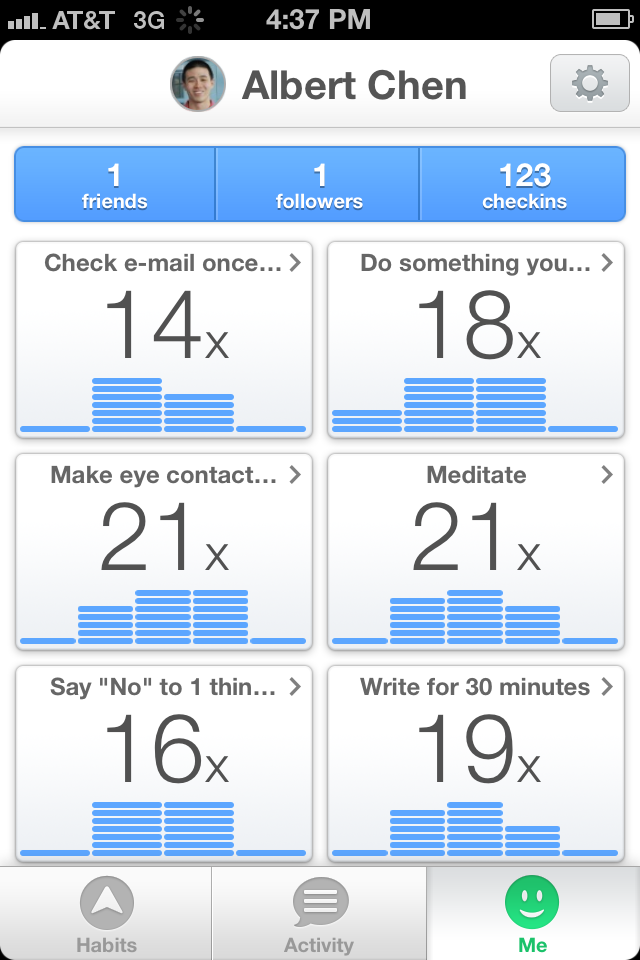
3) I will post a screenshot of Lift for daily habits that week.
_____________________________________________________________________________


Orange indicates scheduled bursts of work on most important projects. I can work on those projects other times, but not in focused bursts (to avoid exhausting my mental energy).  Blue indicates other commitments. Everything else gets crammed into the white spaces.
Lift on iPhone for the past 2 weeks.


_____________________________________________________________________________

Tier 1: Scheduled Bursts

  1. Lab (most important project- 2 related experimental protocols I've never done before and will yield the missing data required for submission)
  2. Literature review: 15 papers read in-depth, 30 skimmed, 100 abstracts. Aiming to fill in the gaps in my knowledge.
Rules: 
  • Scheduling: Must schedule these in advance at the beginning of the week for at least 3 hours each. I treat these as commitments. These are non-negotiable (overrule other things that come up, like meetings). However, I will not overly fret about making an "ideal" schedule ahead of time. Perfectionism and over-planning are forms of procrastination.
  • Distractions: I shut off my phone/Internet and isolate myself as best I can. If I give into ANY distraction, I must stop and mark it as a failure, and report it on this blog. If I decide an unexpected interruption is important and urgent enough to stop what I'm doing, it is not a failure, but I make a note of it to see if I can find a way to avoid it in the future.
  • Focus: Use a timer for 60 continuous minutes (optional to do more on given day after a 15 minute break). Increase by 10 minutes after completing 10 successful sessions in a row.
  • Visible Progress: Have something to show for each session. This can be in a summary in an idea notebook, an updated master project document, an updated manuscript, talking to my PI, prepping slides for lab meeting, etc
  • Breaks: At least one day a week, I cannot work on my most important projects
_____________________________________________________________________________

Tier 2: Worthwhile Habits

  1. Check e-mail/FB/news/Feedly once a day
  2. Write 30 minutes per day
  3. Make good eye contact
  4. Meditate
  5. Do something I fear
  6. Say "no" to one thing
Rules:
  • Aim to do these everyday. Accomplish as many as possible early in the day
  • Checking e-mail a single time is the most important and most difficult. For motivation, as soon as I check a 2nd time, I am barred from recording more habits for the day. At other times, Gmail is blocked from my computer, and Mailbox is put on the last icon screen of my phone. I do check "important" e-mail folder 1 extra time per day. It is also OK to open e-mail to obtain information necessary for a project, but getting distracted by unrelated e-mails constitutes failure

Monday, December 17, 2012

A Unified Theory of Albert's 2012

It's been a while since I've blogged. I can feel a little anxiety, a little tightness in my chest, likely representing some silly fears: "How do I choose which blog concept to start off with? What if it takes a really long time to get back into the blogging mentality? What if it's obvious that I'm out of practice? What if…" Actually I found myself struggling to explain the anxiety while writing that, so I'm not so anxious anymore. I let it go.

It often feels like the same problems plague us year after year. Everyone has bad habits they'd rather eliminate (wasting time on the Internet, poor eating, unnecessary arguing with loved ones, anxiety in X or Y situation, etc). A big one: procrastination. I was going to write this blog entry on Friday but I put it off just to watch Netflix. I did procrastinate- just not nearly as long as I used to, and I didn't beat myself up over it. Same goes for everything else nowadays.

So how did I actually write this blog entry? I just started. I told myself, "Let's just see where this goes. Quality doesn't matter. Two paragraphs, go." Now I'm on my third.

Now, "Just start" probably sounds like really trivial advice. I probably heard this "Just start" advice years ago, and it never helped me stop procrastinating for all these years. So why do I claim that this one little trivial statement is now making a marked difference in my life and my work?

Because in 2012, I deliberately and consciously focused on this little piece of advice. It's one thing to be aware of an idea. It's quite another to focus on an idea long enough to realize when it's applicable and then to execute it. I wake myself up frequently from my daily routine and remind myself that I need to "just start." If I can say I accomplished anything this year, it's that I have trained myself to pay attention to what I'm doing, and more importantly, what I'm thinking at any given time. This is way easier said than done. It took a year of recognizing this was the underlying problem and several months of serious work. 


The Actual Grand Unified Theory
So what unifies all my pursuits in 2012 is my awareness of what I'm doing. For the rest of the blog entry, I'd like to break this up into three synergistic ideas and then offer some lessons that go along with each one. It's not particularly organized or detailed, but many received deeper treatment in past posts, and many will in the future.

1. Think about thoughts. You can call it "Mindfulness" if you want, but this essentially allows me to be my own psychologist. This allows me to figure out which thoughts are getting in my way, and which ones will help me achieve my goals.
  • Stop repeatedly thinking about things. Pointless. Replaying bad memories, regrets, future fantasies, upcoming deadlines, someone who was inexplicably mean, something wrong in my life. The solution was simple: think about what I can do about the situation today. If I can do something, do it. If not, think about something else.
  • Stop stressing. I used to think stress was a necessary evil that helps get stuff done. But stress is only correlative. Thinking objectively about the problem and executing a solution is what actually gets stuff done. Stress hormones only cloud the mind: they're evolved for fight-or-flight. To get stuff done without stress, I re-frame situations to motivate myself positively: treat the task as an opportunity, not an obligation
  • Stop judging other people. It's easy to do this subconsciously. These judgments will never make a single difference in the real world. It's a waste of brain power.
  • Instead, pay attention to the present. This makes it easier to appreciate what I have, and it prevents me from engaging in the useless thought processes listed above.
  • Keep a journal of my thoughts, ideas, important events. I now write down 1 to 5 things a day about my thoughts and daily situations, plus specific things I could have done to handle them better. Then I do them next time.
2. Deliberate Practice. Thinking about thinking allows me remind myself frequently to implement behavioral changes, so I can break old habits and develop new skills. Deliberately expose self to small challenges and then take on progressively more difficult challenges. Treating things as practice frees me to experiment, so I am more likely to make progress.
  • Think about thoughts. What, again? Well, the issue is that it's difficult. Or more precisely, it's hard to remember to think about thoughts, and some thoughts are so powerful and ingrained that they take persistence to eliminate.
  • Social anxiety. Everyone experiences social anxiety in at least one situation. It can be eliminated through practice. Identify the situation that makes you anxious (eg public speaking). Deliberately put yourself in that situation (offer to give a toast at a party) rather than waiting for some obligation to force you into it (eg best man toast). Observe your anxieties. Acknowledge them. Explain to yourself why they are irrational (they usually are). Think of something specific you can do at the moment (e.g. poke fun at yourself and get the audience laughing). From that point forward, you already win, because you already made progress. Everything else is just fun, and if you embarass yourself, who cares?
  • Honesty. I don't just mean not telling lies. I mean revealing things to other people that may bring judgment. I've discovered that when I reveal risky things to people, they will trust me more, not less. No one believes that anyone else is perfect, so revealing a secret won't hurt. This is really difficult, especially society says such things are stigmatized (this is a self-fulfilling prophecy, unfortunately). Difficulty can be overcome with practice.
  • Generating ideas and being creative. You can train yourself to be creative. You can train yourself to not accept things the way they are and to constantly ask "what if?" Just practice writing down ideas.
  • Take deliberate breaks. If I keep working until I'm exhausted, I'll involuntarily take a much longer break and actually get less done. I also stop thinking about thinking, so I fall back on old bad habits (eg wasting time on the Internet). Instead, I now take frequent, short breaks. It's hard to remember to do this, so I practice it.
3. Life is an experiment. There are no stakes, only opportunities. My brain pays attention at a much deeper level while experiencing or doing something new.
  • Try new things, all the time. This felt like the longest year of my life- in a good way, because I deliberately tried lots of new things. Also, trying new things has made discover that I can do things that I always told myself that I couldn't do. I never thought I'd ever be able to walk up to a random cute girl in a cafe and take her out on an instant date.  I never thought I would ever train for a triathlon. I never thought I'd actually have a blog, even though I wanted one.
  • Meeting a new person and don't know what to say? Conversation turning boring? Try saying something provocative and risky, something that you personally find entertaining or funny. Play with the other person's reactions. If they are turned off by it, who cares? It's not a person you'd get along with anyways, if they don't share your sense of humor. And if they do find it hilarious, you've just found yourself a friend.
  • Make your own way. Don't be afraid to stick out, no matter how uncomfortable it is to have others judging you. Don't get stuck in the mindset "College => job => stable career => significant other => marriage => house in the suburbs." Society tells you that this is what you're supposed to do. You might be 100% happy doing this, but you should do it because of reasons that you have established for yourself, not because society tells you to. If you're doing it for your own reasons, you will get more out of it. And this might not be what you want to do, and you should not let friends or family pressure you into following a set path. 
  • Never be afraid of failure. I realized that I was dramatically overestimating the consequences of my choices. Once I started taking risks, I started seeing that small, fun risks are everywhere.

Finally, laugh at yourself. I'm laughing at this blog entry right now.

Wednesday, August 8, 2012

August goals; capturing your thoughts on paper


20th post! Not doing any special post to celebrate- I'm just noting it. I considered an epic, deep post (yeah, right) but today is going to have to be quick- it's a busy week as usual.

You all know that I was a little obsessed for a while with setting goals and tracking them. I developed a single system in Evernote and stuck with it. The rigidity was definitely worth it- I developed a lot of discipline and I got used to reminding myself of my goals frequently. Furthermore, I really liked having just a few primary goals for the month that I stick by, not letting myself get so excited about other ideas that I lose focus. What I've found is that this really makes me feel like I have a "theme of the month" which is great motivation. But now I've moved into an experimental phase, playing with incentives and expanding my thoughts on what I truly want to accomplish. You know, the "why" rather than the "what." Recently I've tried two new systems, one of which is described below in my August goals. I think I'll save the other for a post in the near future (it's a web + smartphone app).

My August goals are:
1) Make tally marks each time I lose focus at work. This is a neat trick and it's helped me a lot in the last week. Essentially I have a sticky note on my laptop keyboard that says "Focus." I catch myself every time I feel like I'm about to do something unrelated to the task at hand (such as randomly checking Facebook or the news for no reason), unless I explicitly give myself permission to do it. I make a tally mark, remind myself of why the task I was performing was important, and get back to work. If I actually get to the point of checking Facebook and getting distracted, then I make two tally marks. During breaks, I may explicitly give myself permission to visit a particular website, and even then I make sure I don't continue clicking on links forever.
1a) Make tally marks each time I find myself having negative thoughts. This is auxiliary to the first point, and is accomplished in the exact same way. There's no point to worrying incessantly about something. Whether something is going badly or not is useless information to me- in fact it will just distract me from doing what I need to do. If something is worrying me, then I should ask myself "Can I do anything about it? Right now?" If the answer is no, I stop worrying and focus on something I can actually influence. If the answer is yes, I either do it or make plans to do it. This is a game I've been playing in my head for a while, and I found that having an object (piece of paper) to dump this on helps me push away the thoughts that are bothering me. That brings me to my next goal.
2) Keep a pocket Moleskine journal. I've resisted keeping a dedicated paper journal for many months now. I figured- I have Evernote to record all my thoughts! Everything backed up in one place! But it's just too clunky on my iPhone while I'm on the go, and I really need to be able to draw diagrams and integrate them with the text. Accessing a stickied page in a paper journal is so much faster than pulling up the relevant note on my computer. I tried a Hipster PDA for a bit but it didn't work out. Anyways, I've used this for the past week to develop my thought processes on my values, my short- and long-term goals, my ideas, etc. Putting it on paper (or Evernote) helps you pare down the bazillion things going on in your head to just the most important things. I originally disliked the lack of structure in the Moleskine (and you can't copy/paste templates like in Evernote)- but I've come to understand that forcing yourself create a system from scratch for organizing your thoughts is important for, well, personalizing your personal development. By the way, if you haven't started recording your thoughts and goals in any way, I highly recommend you start. If time is a worry, just know that it will save you time. Here's a wealth of productivity systems you can implement in a Moleskine.

My red Moleskine. On my computer for size comparison- it fits neatly into my pocket.

A page from my Moleskine. I made a thought process flowchart in response to feeling guilty about not getting enough done in lab. I asked myself a couple of key questions that completely modified my perceptions and put the work I did that day in context. In the end I concluded that my other priorities were more pressing and so I was at peace with myself. Those key questions are labeled 1, 2, 3, and 4 in the flowchart and lead to specific actions I should take (eg not worry or find a specific way to fix it). Then I solidified it in a Moleskine flowchart- so I can refer back to it in the future so I don't stress myself out in the future unnecessarily.

3) Be productive in the evenings learning information or a new skill that is unrelated to labwork. I don't think I have time this month to keep a consistent side project up on top of my Moleskine experimentation, so I figure why not just keep my mind fresh. I'm reading a book about dishonesty (thanks Dale!), learning some coding, learning some memory tricks, doing logic puzzles, and whatever else. The primary reason I'm keeping busy at night is that I've found it helps me sleep a lot better than if I just watch 30 YouTube videos.

Finally, I have started using a productivity web app for my goal tracking. I'm using it to remind myself of a bunch of other goals that I'd ideally like to accomplish a few times a week. Because of the way the website works, I don't need to think about them as much as my primary goals, so I don't have the focus issue that arises when I have too many goals. I will share after I explore it a bit more.

Sunday, July 1, 2012

June review, July goals, and sustainability

It's July 1, and it's time to do my monthly review! Specific goals for each month, and be honest with myself about how I did and how much more I can take on. As a reference, here are my June goals.

June

The name of the game is sustainability. Sometimes sustainability can be achieved in non-intuitive ways. For example, in a previous post I described how I was going to warm-up at the beginning of idea sessions by doing a 5x5 idea list (based on things I should be thinking about everyday anyways) before my "real" idea list of the day. While this sounds like way more work, it actually results in finishing my idea habit in LESS time and thus is MORE sustainable. Since I've implemented it, I've never had trouble finishing my idea habit within 30 minutes (including associated reading). And that's because it just gets my brain working on actual ideas rather than worrying "is this going to be a good idea list?"


I work out almost every day without needing to give it a second thought. It's just part of life. I have no problem dropping everything at any given time of day, changing, and running to the gym. This is exactly what I imagined doing with my June goals. The entire point of doing a 30-day trial where I focus intensely on a handful of goals is to overcome the activation energy barrier, and then I can keep doing it without using up mental willpower. In particular, generating ideas and reading the scientific literature on a daily basis proved to have just as much utility as I had originally imagined. Thus, I have a conscious motivation to keep doing them. I just needed to get started. Furthermore, I've simply become used to doing them, and quite possibly I've become emotionally attached to them (in a good way). Once this happens, not only is it easy to continue doing them without all this deliberate tracking, but I subconsciously feel like something is wrong if I haven't completed them yet on a given day. Thus, it is sustainable.

I will continue idea generation and reading, but I won't be tracking them daily.

I'm much happier with my goal of waking up at 6am than the graph would suggest. I've been tracking my goals in a binary fashion- yes I woke up at 6am, or no I didn't. But simply focusing on waking up earlier has helped me stop wasting time at night and just get to bed, and I have more willpower to get my butt out of bed. Hence, my average waking time has shifted from 9:30am to 7:30am, and that has been great for productivity. I used to think I'm not a morning person, using that as an excuse not to wake up early. Boy was I wrong.

July

Conversely, while my "Lab Plan" goal looks like a success on the graph, there was way too much stuff for me to juggle in lab to really plan anything long-term (to remind you, I'm already pretty happy with my ability to plan within a day). While I worked on my Lab Plan most days, it never made any real impact because it was too unfocused.

Fortunately, my research project has gotten to the point where I just need to hammer out and repeat a series of known experiments. The essential story and elements of a publication are all present, and we've decided to scale back some of the more interesting but technically difficult experiments, and save those for a second publication. Hence, July (and August) is going to primarily about getting all these experiments done, and I'm going to focus my Lab Plan on just that. 3 MIEs (most important experiments) per day planned out for the entire month, and stick to it.

This month there's not going to be much time to develop new habits and work on other goals outside of lab. If I take on too much, it will no longer be sustainable. However, I feel like I should solidify one skill into a daily habit: writing. My goal is to write 30 minutes per day, and much of this will be my paper, though some of it will be my blog. There's no reason to have 100% of my experiments done before I start writing a manuscript. Some days I will write more, for example on days that I'm publishing this blog, or simply whenever I have the time and the ideas.

However, I would go crazy if I did nothing new. On this point, to hell with sustainability. (By the way, this isn't really a habit but an attitude: I generally try something new everyday). This may seem random, but I'm going to learn the Python programming language and find ways to use it in my work. I have some experience with Java but as far as I can tell Python is easier and more intuitive. I'll probably start with some csv files and use it to convert experimental data from one format to another, something that I've been doing manually by copying and pasting. If anyone has any ideas on how I can use Python in my work, please let me know.

To summarize, I have 3 primary goals for July.
1) Lab plan. Plan out experiments long-term rather than just daily. Primarily just experiments related to a publication (hopefully!)
2) Write 30 minutes per day
3) Learn Python. Each day, work on it until feel like I've learned or done something interesting. Time limit 30 minutes per day unless I'm applying it to work.

Tuesday, June 19, 2012

Update: Tracking my Monthly Goals


I briefly mentioned at the beginning of one of my recent blog posts that May felt like it lasted the equivalent of 3 months. It's still true- when it's Tuesday, the weekend feels like it happened a week ago. Why? I couldn't really put my finger down on this until I started thinking about this blog post. I realized I'm spending far more of my waking hours fully conscious. I'm no longer shutting down my brain for hours everyday by wasting time on the Internet. I'm deliberately planning and working towards my goals and developing my habits. Therefore, it feels like I have three times as much… time. Concrete accomplishments and productivity are a natural and happy outcome, but they are almost incidental at this point.

Today is an update on the goals I established at the beginning of the month.

I had 5 goals that I established for myself this month. These are, of course, in addition to everyday work.
  • Focus: An incredibly important meta-goal. I'm trying to stop myself from becoming distracted by cool-sounding goals other than the 5 I've listed here. It's way too easy to move from goal to goal because of the allure of novelty, at the expense of never fully internalizing any habit and never satisfactorily completing any goal. I have specific criteria for checking this off each day, based on how many of the following goals I finish each day and how early in the day I finish them.
  • Idea habit: The most enjoyable goal so far. Each morning I spend up to 30 minutes coming up with lists of ~10 ideas, to actively develop my creativity. These can be relevant to my day or not. Some example lists.
  • Wake up at 6am: This one is fantastic when I actually do it because it's a productivity bonanza. However, waking up early is not a priority when I have evening social obligations or when I'm hosting someone at my place.
  • Reading habit: Keeping up with the literature is critical to any career in science, and I've been neglecting it. I try to read at least an hour each day, or read to the point that I feel like I've gained an important insight. I'm also trying to develop a systematic way to proceed through the literature, but I've made minimal progress.
  • Long-term lab plan: This one didn't really work out as I hoped. I've been treating it as a two-step process. First, developing a list of experiments that would be critical for proving a case in a manuscript. Second, putting it into a calendar format with 1-3 critical experiments I could perform each day in addition to run-of-the-mill labwork. However, I haven't actually done the second part because the first part keeps on changing (ah the realities of science).
I'm using Evernote to keep track of both my "Big Rocks" for each week as well as my progress on goals.
And how have I actually been doing? This morning I'm experimenting with graphing my results and seeing if it's useful.

Yes, I used Microsoft Excel to do this. So sue me.
Clearly, I'm having bursts of productivity (at the beginning of each week, I noticed) and then I slip up as the week goes on. That's just good to keep in mind as I finish the month- I don't necessarily have a plan to correct it. Notably, I'm pretty happy that my reading/plan habits are hovering in the 60-80% range, and the idea habit is a stunning success.

Observations on how I can keep up each habit:
  • Focus: When I have an idea for a self-improvement project, I just write it down in a note in Evernote and then forget about it until it's time to make next month's goals. Don't want to get distracted. Also, waking up early gives me a boost of motivation that allows me to finish all my goals early in the day.
  • Idea habit: Just continue my excitement over being creative each day. Also, I want to try mixing my already-generated ideas in non-intuitive combinations. That's also one reason why I share my ideas- because maybe one of your ideas will have sex with mine have a bunch of little baby ideas.
  • Wake up at 6am: Have something I'm excited to do that day. My buddy Jake mentioned this piece of wisdom: "If you don't know why you're getting up in the morning, you should just go back to sleep."
  • Reading habit: I can really only accomplish this when I drag myself away from lab to a cafe somewhere and tell myself "OK you are going to read now." Perhaps I should start reserving a specific timeslot for this each day.
  • Plan: Just start with the calendar. Use the calendar as my mechanism for generating experimental ideas, rather than trying to list out all experiments first and then stick them into a calendar.
Finally, I have another habit that I've picked up even though I'm not actively focusing on it. And its quite simple: try something new everyday.

Monday, May 28, 2012

Thank you and monthly reflections


Hello! Well, this is now blog entry #7, and I've essentially succeeded at my public goal of writing 2 blog entries per week for a month! Technically I still have one more before I can pat myself on the back, but I'm saving Wednesday's post for something else (A.O., don't give it away in the comments). I'd dearly like to thank all of my readers for following me in this mini-journey. It's sometimes a little addicting (and vain) to watch Blogger track the # of views after I've posted each entry- but I just find that having an audience for my thoughts to be really good motivation to think more deeply. 

But I think going forward, I'm going to modify my blog goal a little bit. First, two major blog posts per week has been sucking up a lot of time- I know it will get easier, but I think I can cut down. However, one blog post per week doesn't seem like enough. Second, I've found that while I'm in the writing process, my blog posts usually balloon to far longer lengths than I originally intend, and I'd like to work on the art of writing concise, quantized posts that are still useful. Thus, I'm going to write 1 major blog post per week, and 1 short post per week (1-3 paragraphs).

Speaking of goals, since the beginning of 2012, I've been doing monthly assessments of how my life is going, monitoring the progress I've made on my goals. It's almost June 2012, and this blog seems like a logical forum for me to flesh things out. I always have a whole bunch of goals that I set for myself and I'm constantly generating new ones as I go through everyday life. I make some progress on all of them, but never satisfactorily. Sure, since the beginning of the year I've definitely gotten better at seeking out interesting strangers to talk to, gotten a lot more organized, been keeping up with my friends and family long-distance, wasting less time on the Internet, keeping my e-mail inbox empty, and reading a lot more. But I think what I'm missing is focus: because I have so many goals, I find it hard to pursue these goals to the point where they have a measurable impact on my life. Also, without a way to internalize and constantly remind myself of my most important goals, it is way too easy to get distracted or to waste time. Finally, having so many goals just makes me stressed that I can't handle all of them.

Writing regular blog posts is one of the few goals that I've been fully satisfied with, and I think it provides two major hints as to how I can solve my focus issue. 1) Announce and make public all of my major goals (i.e. in this post). 2) Simplify. Focus on just a few goals and don't dedicate significant time to anything else until those goals are achieved each and every day, each and every week. 3) Review- throughout each day, review my priorities for the day and ensure that my goals are being achieved.

This month, I'm going to focus on 4 major goals that I've been putting off. 
  • Generate a list of ideas everyday. I'm a fan of James Altucher's blog, and one thing that he does is write down lists of ideas every morning. Basically exercising his "idea muscle" so he has no problem being creative when the situation calls for it. He's even turned some of the ideas from his list into businesses. Some lists I could generate: 30 things I'm grateful for, 10 things I did that were productive in the last week, 20 chapter names in my own autobiography.
  • Wake up at 6am every morning. I did this in January and it was fantastic, and I have two good tools at my disposal to keep up this goal: 1) Sleep cycle alarm clock. This iPhone app (see photo on right) uses your iPhone to pick up vibrations to detect when you are in deep REM sleep (muscle paralysis) and when you are in the lighter stages of sleep. You give it a time interval for it to wake you up (like a normal alarm clock) and then it will only wake you up if you're not in deep sleep, so when you wake up you feel far more rested. (credit: first found out about this from my friend Dale's blog) 2) Practice, literally. Lie in bed, set the alarm clock for 5-10 minutes later, and get up immediately and perform a putative morning routine. Idea from Steve Pavlina's blog. 
  • Read at least a full paper and 3 abstracts/intros/discussions every day. I briefly discussed this in my post from May 13, and I think that establishing regular reading habits right now in my training should be a top priority. Too often at lab my mind is so focused on experiments that I have a hard time setting aside time for reading, unless it's a paper that's directly relevant to what the lab is doing right now.
  • Develop a long-term lab plan with all of the experiments I am going to perform over the next month or more. So far I've only been planning each day's experiments in any real detail (which has been highly successful). I can anticipate all of the big things that I need to prepare for long-term, but it's hard to evaluate how much progress I really make over a month. My plan is to write the outline of a potential paper, look at all of the components, and decide when exactly I can perform all of them. Then, I will review it daily and decide whether or not I've made progress towards completing my plan.
Finally, I'm going to keep up two other habits to make sure I don't slip. 1) Read 40+ pages of a book every night, and 2) Skype with family once a week, and skype to catch up with a friend once a week.

All of these are going to be on a notecard in my pocket, on a post-it note on my computer, on a post-it note at my lab desk, etc.
1) Focus on stated goals to the exclusion of all others. Don't get distracted by new ideas- save them for next month.
2) Generate a list of ideas. Or, find another mentally challenging task to perform.
3) Wake up at 6am.
4) Read paper + 3 abstracts
5) Develop long-term lab plan

I thought about acronyms, mnemonics, and other mental tricks to internalize these goals. In fact, I used my idea habit to generate a whole bunch of ways to internalize "focus, ideas, wake up, read, plan." These ideas can be as ridiculous as I want. Here are three highlights:
Mnemonic: Furious Igloos Wear Religious Placemats
Link system: The focus (of an ellipse) had an idea orbiting it. Then the idea exploded and woke up from a nightmare. In the wake of this event, reading was banned. Fortunately, the Cylons have a plan to get reading back.
Mnemonic: Fine Ideas Want Radical Processes

Somehow, the third one jives with me the most. Hence, I will internalize Fine Ideas Want Radical Processes. I'll probably back it up with my link system story.

About Me

MD/PhD student trying to garner attention to myself and feel important by writing a blog.

Pet peeves: conventional wisdom, blindly following intuition, confusing correlation for causation, and arguing against the converse

Challenges
2013: 52 books in 52 weeks. Complete
2014: TBA. Hint.

Reading Challenge 2013

2013 Reading Challenge

2013 Reading Challenge
Albert has read 5 books toward his goal of 52 books.
hide

Goodreads

Albert's bookshelf: read

Zen Habits - Handbook for Life
5 of 5 stars true
Great, quick guide. I got a ton of work done these past two weeks implementing just two of the habits described in this book.
The Hunger Games
5 of 5 stars true
I was expecting to be disappointed. I wasn't.

goodreads.com